
Author Archives: Jürgen

The art of Ferdinand Bauer

ferd-bauer-banksia-coccinea-01-800x136

Truth & Beauty

The Australian botanical works of Ferdinand Bauer

Ferdinand Bauer (1760 – 1826) was an Austrian born botanical illustrator. At the turn of the 19th century he was one of six scientists selected to join Capt. Matthew Flinders in the scientific expedition that would chart Australia’s coastline and document its flora and fauna. Robert Brown was the botanist of the expedition. Bauer returned to England in 1805 with sketches of more than 1500 plants.

This exhibition draws on the McCarthy Collection of prints from the Flinders University Art Museum, illustrated publications by and about Bauer and plant specimens from the State Herbarium of South Australia to explore the fusion of art and science in his remarkable work.

Please drop in at the Flinders University City Gallery on the ground floor of the State Library of South Australia. The exhibition runs from 3 Dec. 2016 to 5 Feb. 2017. Opening hours are: Tue.–Fri. 11am–4pm, Sat. & Sun. 12am–4pm. Note also the public lecture by Prof. David Mabberley on 3 Dec. 2016, 2pm (see exhibition poster below).

This is a Flinders University Art Museum exhibition in partnership with the Santos Museum of Economic Botany, Botanic Gardens of South Australia, co-curated by Fiona Salmon & Madeline Reece (Flinders University) and Tony Kanellos (Botanic Gardens of South Australia).
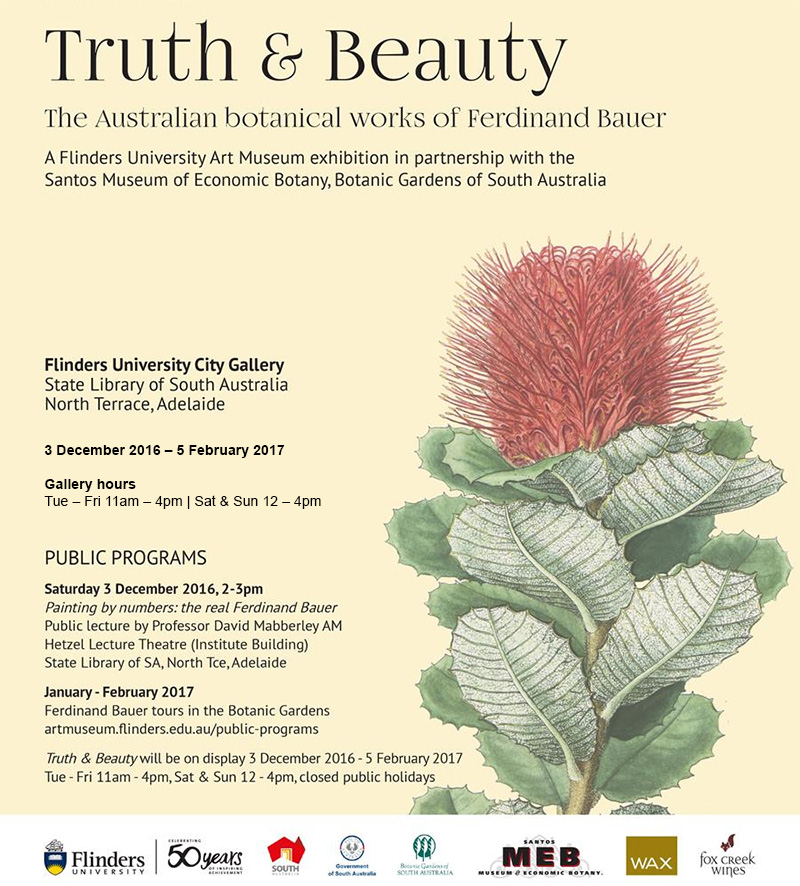
Top banner & exhibition poster: Ferdinand Bauer, Banksia coccinea from Illustrationes florae Novae Hollandiae, stipple engraved on copper, hand-coloured 1813, published 1989 by Alecto Historical Editions in association with the British Museum (Natural History), London. Acquired by Flinders University with the support of the University of the Third Age in commemoration of Flinders University’s 50th Anniversary.

Plant* of the Month: Dec. 2016

State Herbarium staff member Chelsea Novice holding a specimen of Sarcothalia radula. Photo: B. Baldock.

DEWNR‘s last Park of the Month for 2016 is Canunda National Park on the South Australia’s south-eastern shore. Fittingly, the State Herbarium has chosen an alga, Sarcothalia radula (Esper) Edyvane & Womersley, as Plant* of the Month (even though technically speaking, red algae are not plants).

[* = and other organisms traditionally studied by botanists]

Bigger and bolder at Canunda

The South East of South Australia − including Canunda N.P. shores − is rich in algal species, particularly red algae. An upwelling of cold, nutrient-rich bottom waters occurs in summer, producing both a large diversity and large sizes of some algae (see Butler et al. 2002, 900kb PDF). For example, the Giant Kelp (Macrocystis pyrifera) and Bull Kelp (Durvillaea potatorum), are common big browns along rocky parts of the Canunda N.P.

But the reds can be big, too.

Sarcothalia radula, base of alga with holdfast. Photo: B. Baldock.

Sarcothalia radula is a bright-red-purple alga looking like a filmy, plastic sheet that reaches 1½ m in height in calm waters. It can be paper-thin, and not surprisingly gets damaged, with holes appearing in the blade. Remarkably for such a large plant, this alga is fixed to rocks at depths of 1-10 m by the tiniest of holdfasts.  How it withstands being swept from its substrate by the surge of water in its habitat is difficult to imagine.

Smaller plants may be lance-shaped, or even appear slashed into narrow strips, possibly a response to depth of water, light and ferocity of waves.

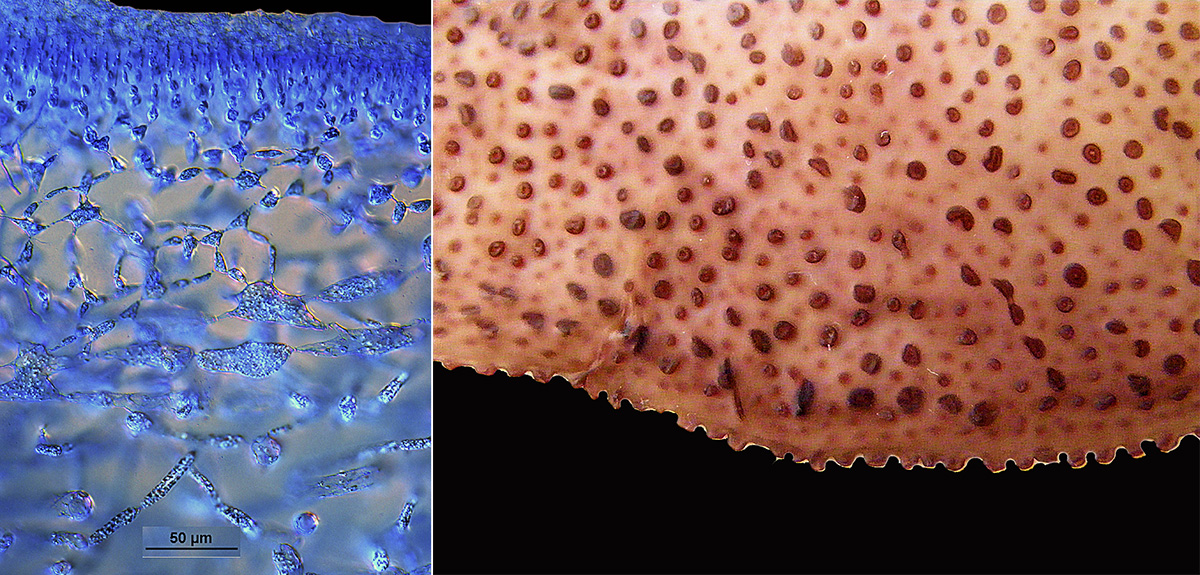
A descriptive common name, giant pimply-sheets, coined in the Algae Revealed fact-sheet  (960kb PDF) on eFloraSA, highlights the strange texture present when a female plant is fertile. Thousands of small, pimply (papillose) bumps on very short stalks are scattered on the surfaces and edges of blades. The common name found on Algae Base, is tongue weed, but fertile female blades must resemble pretty furry tongues when fertile!  In fact, the specific epithet radula, Latin for “rasp” or “scraper” more aptly describes them.

sarcothalia-radula-2x-1200x575

Sarcothalia radula: cross-section through blade (left) and surface view of the “pimply” female blade margin (right). Photos: B. Baldock.

Internally, the microscopic structure of blade cores (image above) shows many-armed cells separated by an extraordinary amount of space. Surface layers consist of compact, outward-facing chains of small cells.

We have some 60 specimens of Sarcothalia radula in the collection of the State Herbarium of South Australia. Globally, the species is found in cold waters across the southern hemisphere.

Perhaps after local storms you may come across this impressive red washed up on Canunda beaches.

Contributed by Carolyn Ricci and Bob BaldockPhycology Unit, State Herbarium.

2012 Bush Blitz report now available online

In November 2012, five staff members of the State Herbarium of South Australia participated in a two week survey on Hiltaba Station and Gawler Ranges National Park. These staff collected vascular plants and cryptogams as part of the Bush Blitz program.

The detailed report prepared for Bush Blitz is now available on Enviro Data SA:

  • Lang, P.J., Kellermann, J., Bell, G.H. & Cross, H.B. (2013). Flora survey on Hiltaba Station and Gawler Ranges National Park: vascular plants, macrofungi, lichens, and bryophytes. Report for Bush Blitz, Australian Biological Resources Study, Canberra. (Department of Environment, Water and Natural Resources, South Australia: Adelaide). 5.9mb PDF.

Area of outcropping granite dominated by the Gawler Ranges endemic shrub Grevillea parallelinervis and by Melaleuca uncinata and Triodia irritans; hill NW of Mt Hiltaba, Hiltaba Station. Photo: J. Kellermann.

A summary of the results was published in:

  • Bush Blitz (2015). Hiltaba Nature Reserve and Gawler Ranges National Park SA 2012: a Bush Blitz survey report. (Australian Biological Resources Study: Canberra). 5.8mb PDF.

The primary survey effort was focussed on Hiltaba Station, which had been recently acquired by Nature Foundation SA, and records were made at 134 sites. Across the two properties the survey resulted in the collection of 782 plant specimens, plus a further 524 plant sighting records. The collections were supplemented by 136 vascular plant tissue samples collected in silica gel desiccant for future DNA analysis.

A total of 88 plant taxa were newly recorded for the Hiltaba Nature Foundation property during the 2012 Bush Blitz Survey. This comprised 36 vascular plant taxa and 52 cryptogams (26 bryophytes, 22 lichens, and 4 macrofungi). In the Gawler Ranges National Park, 21 plant taxa were recorded for the first time, comprising 12 vascular plant taxa and 9 cryptogams. These surveys have made a significant contribution to our knowledge of the flora on both properties.

Extensive area of intact Maireana sedifolia (Pearl Bluebush) Low Shrubland on open plain SW of Peeweena Bore, Hiltaba Station. Photo: P.J. Lang.

The results of the survey and the problems encountered when revising and compiling flora lists were discussed in a presentation at the Bush Blitz Symposium in July 2013 (Old Parliament House, Canberra). Recordings of all presentations from the Symposium are available online.

  • Kellermann, J., Lang, P.J. & Waycott, M. (2013). To the hilt: tackling flora lists for Hiltaba Station and Gawler Ranges National Park.  Recorded presentation (15 mins) by Jürgen Kellermann.

More information on the 2012 Bush Blitz:

BushBlitzLogo_orangeBush Blitz is an innovative partnership between the Australian Government, BHP Billiton Sustainable Communities and Earthwatch Australia. It is the world’s first continent-scale biodiversity survey, providing the knowledge needed to help us protect Australia’s unique animals and plants for generations to come.

Plant of the month: Nov. 2016 (2)

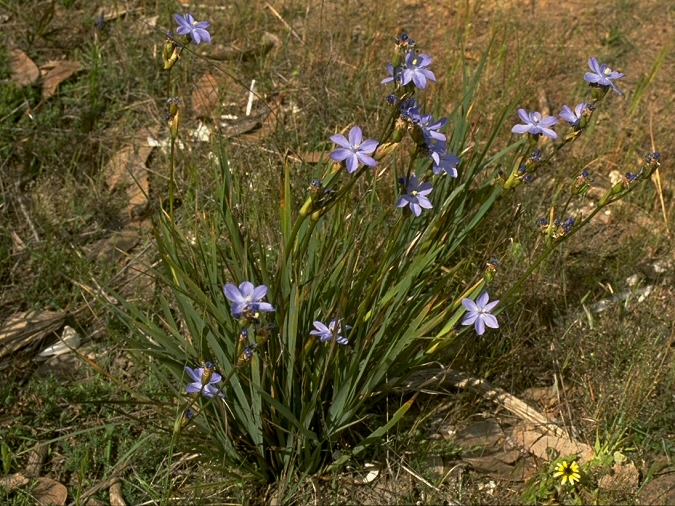
Orthrosanthus multiflorus, Kangaroo Is. Photo: D. Armstrong.

As the second Plant of the Month for November 2016, the State Herbarium of South Australia has chosen Orthrosanthus multiflorus Sweet (morning flag). It is a native member of the Iris family (Iridaceae) found in both Parks of the Month, Kelly Hill Conservation Park and Seal Bay Conservation Park.


Plant a flag in your garden!

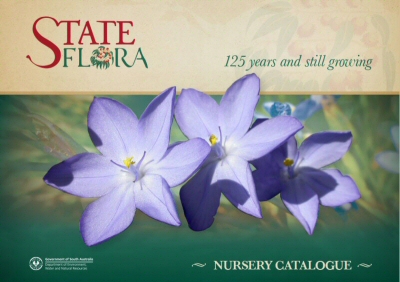
Morning flag is a hardy tufted perennial that is suitable for cultivation in Adelaide (4.2MB NRM gardening brochure) and elsewhere in temperate S.A., provided frost-prone areas are avoided. For further information see the Botanic Gardens of SA Plant Selector and the State Flora Nursery Catalogue (7.5mb PDF), which happens to feature our Plant of the Month on its front cover!

Within South Australia, morning flag is almost entirely confined to Kangaroo Island, apart from several records on the southern tip of Eyre Peninsula and a questionably native occurrence near Inman Valley on Fleurieu Peninsula. It is the dominant ground cover plant in the Rocky River visitor precinct of Flinders Chase National Park, its tough grass-like leaves being resistant to grazing by kangaroos, wallabies and Cape Barren Geese.

Morning flag at Rocky River, Flinders Chase National Park. Photo: D.N. Kraehenbuehl.

In the South Australian flora, the Iris family (Iridaceae) is dominated by introduced species (currently 52 listed in the Census) and these are largely South African garden escapes. Orthrosanthus multiflorus is one of only three native Iridaceae species found here (the other two being Patersonia species). Have a go at growing it and help redress the imbalance. It would make a wonderful addition to South Australian gardens as an alternative to the many introduced ones!

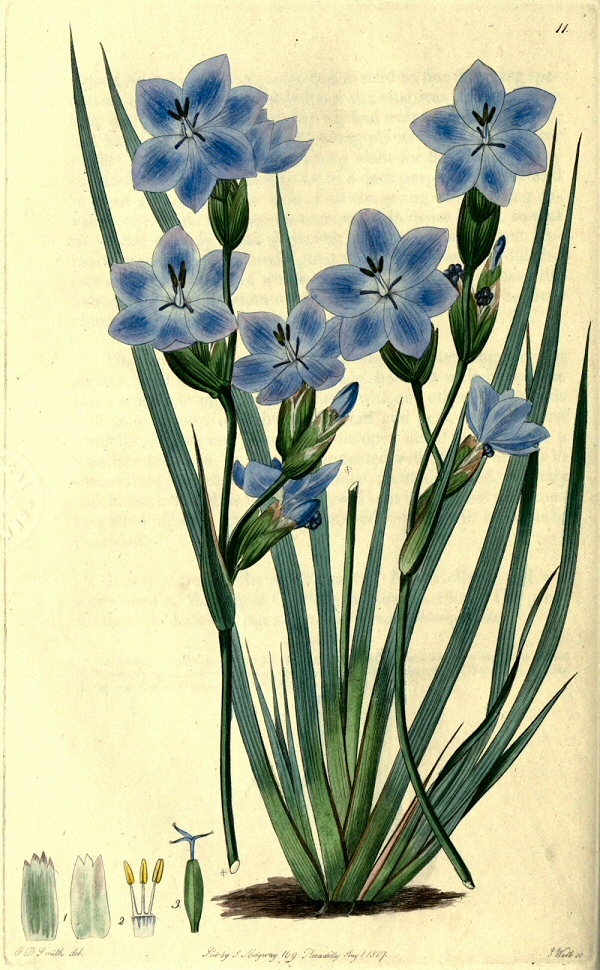
The delightful illustration below by Edwin Dalton Smith was published with the original description of the species by the English botanist and horticulturalist Robert Sweet in 1827 in his Flora Australasica or a selection of handsome or curious plants native of New Holland and the south sea islands (1827-1828).

orthrosanthus-multiflorus-illustration-by-e-d-smith-in-sweet-1827-1828-217355-edit-crop-small2

Contributed by State Herbarium botanist Peter J. Lang.

Plant of the month: Nov. 2016 (1)

Sarcomenia delesserioides, pressed specimen (blades enlarged in inset). AD-A61614.

For November, DEWNR has chosen a pair of neighbouring parks on Kangaroo Island as Parks of the Month: Seal Bay Conservation Park and Kelly Hill Conservation Park. The State Herbarium of South Australia has also chosen two Plants of the Month for November 2016. For Seal Bay, the Phycology Unit suggested the alga Sarcomenia delesserioides Sonder.

Where is it now?

Delicate, filmy, iridescent under water and self-destructive! Sarcomenia delesserioides is a beautiful, translucent red alga found from the Abrolhos Islands, Western Australia to Victoria, often washed in from deep waters. It is difficult to preserve as it habitually dissolves itself when left to die slowly, leaving a sloppy mess on the paper sheet if its collector tries to press it in the usual way.

Streamer-like narrow blades arise from a short stalk anchored by a root-like holdfast. Side blades on short stalks sprout from mid-line veins. Under a hand-lens, you can better appreciate the delicate beauty of the alga. Female plants produce a “forest” of glistening, minute, lollipop-like structures (cystocarps) on both blade surfaces.

Sarcomenia delesserioides, female blades with cystocarps (top image) and male blade with stichidia (bottom). AD-A74861. Photos: B. Baldock.

There are separate spore and male plants which produce miniature, finger-like reproductive structures (stichidia) that make blade surfaces look like furry tongues. Blade tips under a laboratory microscope show single, large, apical cells dividing to form mid-line veins and spreading lines of cells, produced in pairs with mathematical precision, that expand the blade width. As the blade matures and thickens slightly, additional surface cells form ring patterns around larger deeper cells.

The first record of this alga in the State Herbarium is probably that collected by Jessie Hussey at Port Elliott, who was an avid collector of algae during the end of the 19th century. There are 17 specimens from the south coast of Kangaroo Island mainly from the Vivonne Bay jetty. Other collections come from drift or specimens “cast up”. We know the plant actually grows on rock at depth — 38 m — from a dive made off Cape Willoughby in 1989 (a collection that would be prohibited these days because of industrial safety regulations).

Sarcomenia delesserioides, tip of blade (left image) and surface cells (right). AD-A18663. Photos: B. Baldock.

Only two records of this exquisite alga from Seal Bay exist, from drift specimens taken by the late Professor Womersley way back in October 1966. Visits there in the 1950s (2), 60s (3 additional ones), 70s (3), 80s (1) and 90s (2) failed to find the species again. There have been no subsequent collections at the State Herbarium of any algae from southern Kangaroo Island localities, which reflects the penurious nature of algal field work in modern times.

Does Sarcomenia delesserioides still exist in Seal Bay or its rocky environs? Have visitors noticed it and failed to recognise its uniqueness? Perhaps only a serious “algal watch” by local enthusiasts could answer these questions.

The State Herbarium e-Flora has webpages that could help avid beachcombers. Try the Algae Revealed keys and information sheets on www.flora.sa.gov.au/algae_revealed/index.shtml.

Contributed by Carolyn Ricci and Bob BaldockPhycology Unit, State Herbarium.