Interesting algae in the lake

Image by Bob Baldock, Feb. 2014

Botryococcus braunii

This photograph shows a microscopic image of Botryococcus braunii.  Hon. Research Associate Bob Baldock reports that this interesting algae has appeared within floating rafts of filamentous green algae (mainly Oedogonium sp.) in the storagepond of the new Adelaide Botanic Gardens’ First Creek Wetland.

Botryococcus braunii grows as a colony of egg-shaped cells within a tough, gelatinous sheath: individual colonies may cling together by gelatinous strands. Although a member of the green algae, it, and its colonial matrix are usually coloured yellow or brown.  Individual cells store oil droplets, and this feature is currently being researched as a possible source of bio-fuel. — But don’t worry, there is insufficient to set the pond alight!

Bob Baldock is a long-time associate of the State Herbarium of South Australia, responsible for the creation of the Algae Revealed fact-sheet series on marine algae of southern Australia.

The invading flora: a regional account of the assault

Recently, State Herbarium botanist Peter Lang has compiled the numbers of vascular plants occurring in the wild in South Australia for 2013.  There are 4,940 taxa (= species, subspecies & varieties) in the state, of which 1,267 taxa (25.6%) are naturalised alien plants (weeds). A further 232 taxa (4.7%) are questionably naturalised: these are, for example, plants that are found in cultivation and have escaped, but it is not proven whether they will maintain their wild populations. Including these the total for alien taxa is 1,499 (30.3%), or almost one third of plants found in the State.

The graph below depicts the numbers of plants for each of the 13 botanical regions (as used by the State Herbarium). The lowest number of introduced taxa is found in the NW (North Western) region of the State, with only 5.9% of naturalised and questionably naturalised plants. The SL (Southern Lofty) region, which includes Adelaide, the Adelaide Hills and Fleurieu Peninsula, has the highest number of alien plants, 46.4%. As expected, more remote regions, away from large settlements, have fewer naturalised and questionably naturalised taxa.

Weeds are not only introduced through agricultural practices, but also escape from gardens. Plants listed as questionably established highlight potential weeds of the future and warrant monitoring or control, to prevent them becoming established.

Click here to see the original data.

Numbers of native (incl. questionably native), naturalised and questionably naturalised plants in South Australia (as of 11 Dec. 2013)


Stroll around a palaeolake in a New Zealand sub-tropical rainforest

It’s All About the Plants
Tuesday, 4 February 2014—10:00–12:00
Goodman Building Lecture Theatre

by Dr John Conran (Associate Head of School)
School of Earth and Environmental Sciences, The University of Adelaide

The flora surrounding the early Miocene (23 Ma) Foulden Maar palaeolake included a highly diverse Lauraceae-dominated rainforest with macro- and/or microfossils of now extinct species of epiphytic ferns, a wide range of gymnosperms, 10 species of Lauraceae, and numerous other angiosperms typical of present-day New Zealand ecosystems, including diverse monocots. The macrofossils include leaves, flowers, fruits and seeds and in several cases are sufficiently detailed to allow placement onto cladograms with putative modern relatives, improving the phylogenetic significance of the fossils and their utility for dating evolutionary trees (e.g. Fuchsia, Laurelia, Luzuriaga). Comparisons with the ecology of modern relatives to the fossils at the site suggest that the forest included canopy trees, understorey shrubs, epiphytes, mistletoes, ferns, and vines, as well as forest margin pioneers and emergent aquatic macrophytes. The rainforest supported a mixture of wind-, bird- and insect-pollinated species, as well as both animal- and wind-dispersed fruit and seed types.
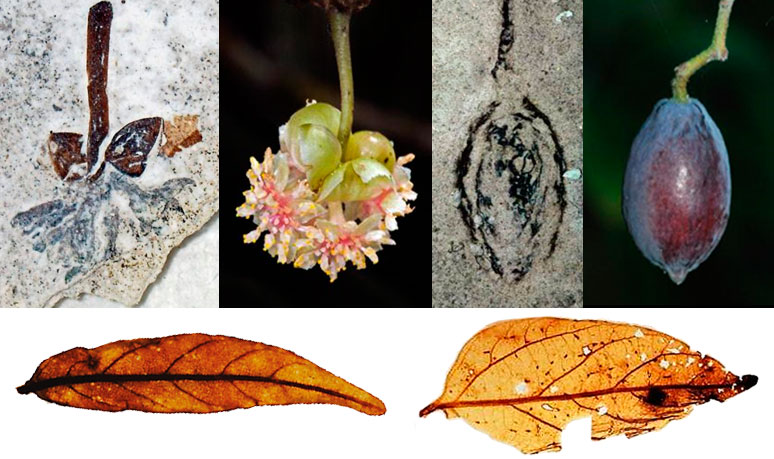
Foulden Flora

Foulden Flora

The palaeoforest most closely resembled a warm temperate to subtropical notophyll vine forest, but was comprised of what are now Australian, New Zealand, South American and New Caledonian elements. CLAMP (Climate Leaf Analysis Multivariate Programme) analysis of fossil leaf morphology at the site also suggests that SE Queensland rainforests are the nearest living climatic proxy. Apparent differences between the in situ macrofossils and the microfossils can be explained partly in terms of local versus regional scales, as well as variation in the soils and underlying geology surrounding the maar. The possible ecology, climate and habitats at the palaeolake and their implications are discussed in terms of the diversity and uniformity of mid-latitude southern New Zealand at the Oligocene–Miocene boundary.

All Herbarium staff, honoraries, volunteers and students are welcome.
Morning tea provided.

[cite as: Southern New Zealand at the Oligocene–Miocene boundary: floristic and palaeoecological characterisation of Foulden Maar.
John G. Conran1, Daphne E. Lee2, Jennifer M. Bannister3 and Dallas C. Mildenhall4
1ACEBB & SGC, School of Earth & Environmental Sciences DX 650 312, The University of Adelaide, SA 5005 Australia; 2Department of Geology, University of Otago, PO Box 56, Dunedin; 3Department of Botany, University of Otago, PO Box 56, Dunedin; 4GNS Science, PO Box 30368, Lower Hutt]
Christmas greetings

Spitzingsee in the Bavarian Alps, Germany

The State Herbarium of South Australia wishes all its friends, volunteers and Hon. Associates a happy Christmas break and all the best for the New Year.  We hope to see you all again in 2014.

Seminar dates for 2014

Spyridium halmaturinum

The State Herbarium of South Australia’s seminar series It’s all about the plants will continue next year. The talks will again take place in the Botanic Garden’s Goodman Building Lecture Theatre (Hackney Road, Adelaide) on the first Tuesday of every month, except January and December, from 10:00–12:00.

The dates for 2014 are:
4 February, 4 March, 1 April, 6 May, 3 June, 1 July, 5 August, 7 October and 4 November.

Topics will be announced on this BLOG about two weeks before a seminar takes place, so stay tuned (and subscribe to get updates). All Herbarium staff, honoraries, volunteers and students are welcome.