Author Archives: Jürgen

Things are never as simple as they appear…

Great fleas have little fleas upon their backs to bite 'em,
And little fleas have lesser fleas, and so ad infinitum.
And the great fleas themselves, in turn, have greater fleas to go on;
While these again have greater still, and greater still, and so on.


Augustus De Morgan, A Budget of Paradoxes (1872)
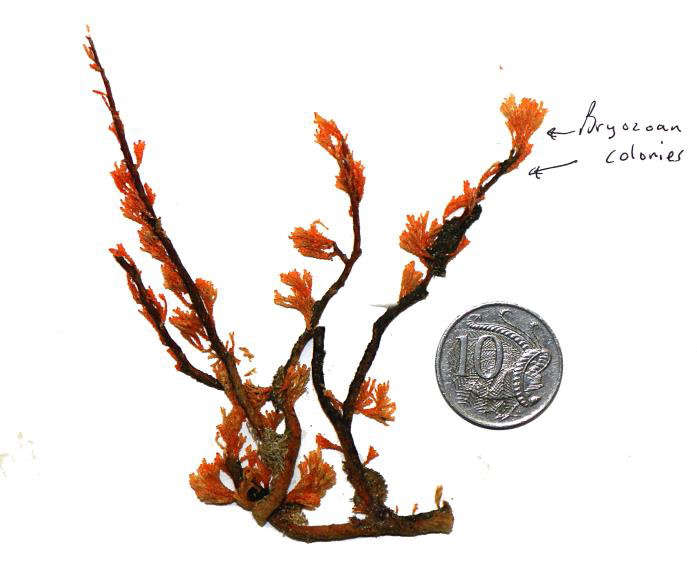
The apparently simple specimen that proved to be a whole community of marine organisms. Photo: B. Baldock.

This small specimen was collected from 21 m deep waters, at St Francis Island, Nuyts Archipelago, South Australia (see also South Australia’s offshore islands, p. 150; 33mb PDF). It was torn from its substrate by the frame of an underwater Baited Remote Underwater Video Station (BRUVS) used to film fish populations as part of the survey of Marine Parks, and was given to the Phycology Unit of the State Herbarium of South Australia in 2015.
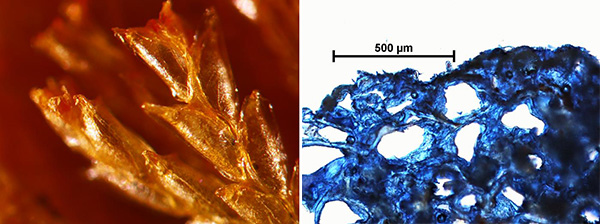
LEFT: Remains of the slightly calcified exoskeletons of individual zooids in the bryozoan colonies. RIGHT: Part of the inter-connected chambers of the tree-like sponge, walls stained blue. Photo: B. Baldock.

At first sight I thought the specimen was simply a group of “moss animals” or bryozoans (probably Canda arachnoides Lamouroux, above left).  But closer inspection proved that the bryozoans were growing on a tree-like sponge full of inter-connected chambers (above right).

In addition, under the microscope, I found four algae – a veritable community coating the sponge. Labelled with red numbers 1 to 4 in the images, below.

(1) Dictyopteris gracilis, delicate sporelings attached to a sponge skeleton (top), which is stained blue, and a single flimsy blade (bottom). (2) Lejolisea aegagropila, female structure (top) and stalked sporangia (bottom), stained blue. Photo: B. Baldock.

The largest, a Brown alga, Dictyopteris gracilis Womersley (no. 1), consisted of sporelings “babies”, getting established on a relatively stable, hard substrate, a requirement for most algae to survive.  They could have grown into quite elegant, leaf-like plants some 200 mm tall. Their growing centres (meristems) are found in the notch at the apex of the delicate filmy blades. See the Algae revealed factsheet for the species (420kb PDF).

In addition, there was a tangled set of microscopic pink threads, Lejolisia aegagropila (J. Agardh) J. Agardh (no. 2), easily recognised from its female reproductive structures (procarps and cystocarps) that resemble glass light-bulbs.  Mixed in with the female plants was another stage in the species life cycle – a spore plant with packets of 4 spores (tetrasporangia) on minute stalks.
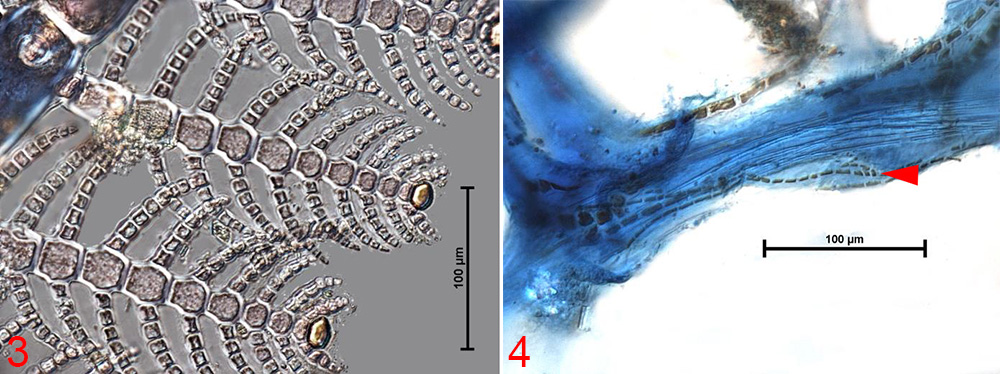
(3) Acrothamnion preisii, elegant feathery (pinnate) side branches tipped with a glistening gland. (4) Audouinella spongicola, minute threads of the Red alga (arrow), running along the blue-stained walls of the sponge which shows ,also, needle-like skeletal spicules. Photo: B. Baldock.

Perhaps the most striking, however, was the Red alga Acrothamnion preissii (Sonder) Wollaston, with its elegant “feathers”, each ending in a glistening gland (no. 3).

The most unusual alga, although obscure, consisted of lines of elongate red cells (no. 4) running on the surface and around the walls of the inter-connected sponge chambers. These belonged to threads of a very simple Red alga, Audouinella spongicola (Weber van Bosse) Stegenga, which, as its name denotes, specifically lives on sponges.
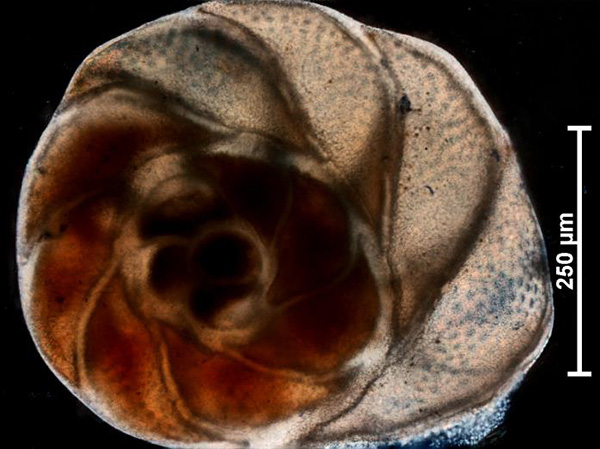
The common, single-celled foraminiferan Discorbis dimidiatus, its shell punctured with minute pores, lives amongst the algae attached to the sponge. Photo: B. Baldock.

There were other microscopic organisms: shell-like unicellular animals (foraminifera), diatoms with glassy walls; and inevitably, bacteria, but I stopped investigations at the plants and animal described above, thinking I had enough evidence to support the sentiment in the adage at the start of this article.

I hope the BRUVS people can continue to send more, minute but nevertheless interesting marine communities to us at the State Herbarium. You never know what will turn up in the marine world.

Contributed by State Herbarium Hon. Associate Bob Baldock.
Plant of the Month: Aug. 2017

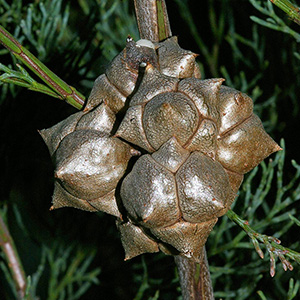
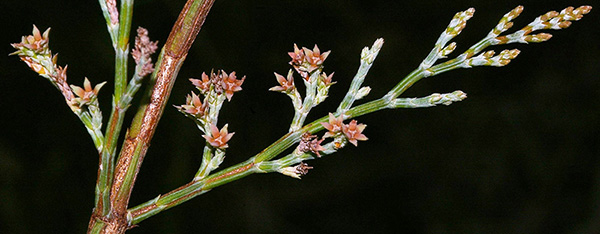
Callitris rhomboidea, branch with immature cones. Photo: T. Robinson.

Plant the Month for August is Callitris rhomboidea R.Br. (Oyster Bay pine), which occurs in DEWNR‘s Park of the Month, Onkaparinga River National Park. It is a conifer from the large and cosmopolitan Cypress family (Cupressaceae), which includes many important timber (e.g. Sequoia sp., the Redwoods of North America) and horticultural species (e.g. Cryptomeria, from Japan). Callitris includes approximately 16 species, 13 of which are restricted to Australia. The majority of these occur in heath and woodlands, extending into semi-arid areas. Recent molecular research suggests that Callitris evolved from rainforest ancestors in response to a drying climate over the past 30 million years (Larter et al. 2017) and in contrast to other Australian conifers, they are remarkably drought tolerant, allowing them to thrive in arid conditions.

Callitris rhomboidea, fruiting cone. Photo: T. Robinson.

This species is commonly referred to as the Oyster Bay pine, in reference to its occurrence on the Georges River, in the vicinity of Sydney (also known as Port Jackson pine). Callitris rhomboidea extends from coastal southern Queensland through New South Wales, Victoria and Tasmania. In South Australia, it occurs chiefly on Kangaroo Island and a few scattered localities in the Mount Lofty Ranges, including the Onkaparinga River Gorge, and the Mount Crawford region to the north. While it is widely distributed, Oyster Bay pine is only locally common, occurring on sand dunes and in rocky areas in heath and woodlands. Callitris are intolerant of fire and preferentially grow in areas that are protected by topography or slow rates of fuel accumulation. However, the Oyster Bay pine can readily regenerate from seed, which are held in the thick woody cones that cluster on fruiting branches. Like many plant species of Australia’s fire prone woodlands (for example, Banksia), fire may act as a stimulus for seed release followed by mass germination and generation of dense, even-aged stands.

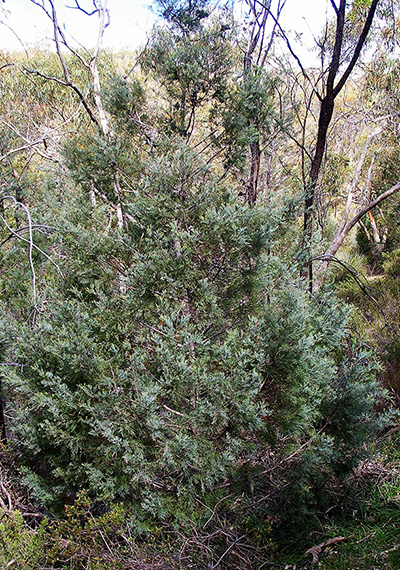
Callitris rhomboidea in Hale Conservation Park. Photo: T. Robinson.

There are two species of Callitris occurring within the Onkaparinga River National Park. Callitris rhomboidea is perhaps best distinguished from Callitris gracilis (Slender Cypress-pine) by the shape of the cone scales on the female cone, which are rhomboidal (hence the name, rhomboidea) and have a distinct point near the apex.

Callitris rhomboidea is ‘Rare’ within South Australia, and has declined in parts of its range as a consequence of land clearing, grazing and weed competition. While the level of decline is insufficient to warrant listing as ‘Threatened’, factors such as high frequency fires and susceptibility to ‘die-back‘ (caused by the fungal pathogen, Phytophthora cinnamomi) are potential future concerns (IUCN Red List 2017).

Contributed by State Herbarium molecular botanist Ed Biffin.

Our journal’s web-site banners

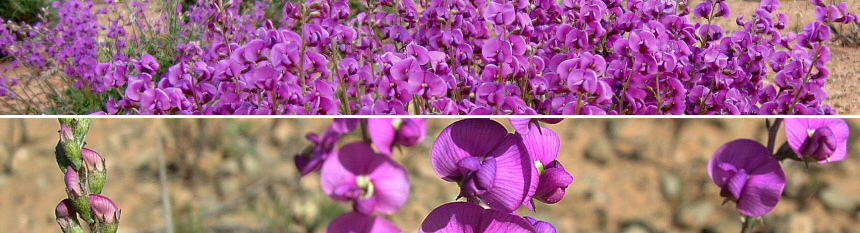
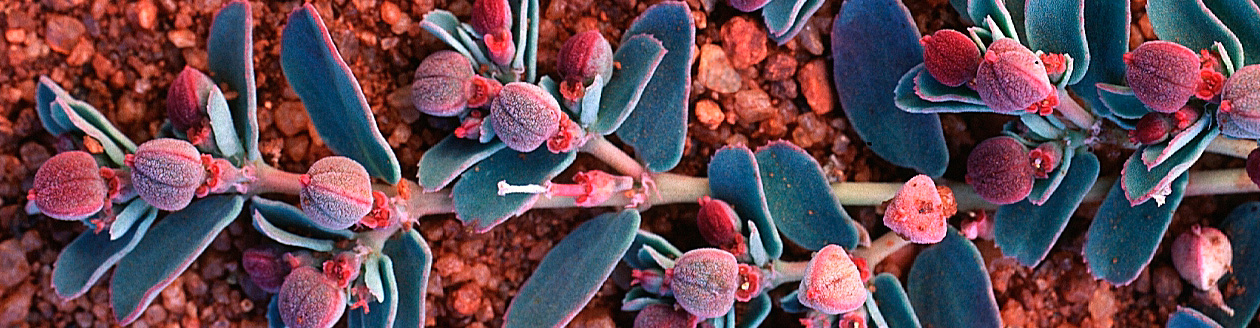
Swainsona formosa. Photo: H. Owens.

This year, the State Herbarium of South Australia‘s journal changed its name to Swainsona.

When browsing the new journal web-site, you might have noticed that there are changing banners at the top of the page. Each showing a different species of Swainsona. The journal was named after South Australia’s floral emblem, the Sturt desert pea (Swainsona formosa (G.Don) Joy Thomps., but there are about 85 species in the genus (see Joy Thompson’s revision of the genus, 17.7mb PDF). Some of these plants feature on Swainsona‘s web-site.

Below you can find a gallery of the banners that are used at the moment. If you click on the image, you will get more information from the SA Seedbank web-site. More images will be added in the future.

More information on the Australian states’ floral emblems can be found in an article by Sophie Ducker (1999, 930kb PDF) and on the Australian National Botanic Gardens web-site.

Swainsona canescens. Photo: SA Seed Conservation Centre.

Swainsona fuscoviridis & S. fissimontana. Photo: SA Seed Conservation Centre.

Swainsona fuscoviridis. Photo: SA Seed Conservation Centre.

Swainsona leeana. Photo: P.J. Lang.

Swainsona microphylla. Photo: R.J. Bates.

Swainsona oligophylla. Photo: R.J. Bates.

Swainsona pyrophila. Photo: SA Seed Conservation Centre.

Swainsona tenuis. Photo: SA Seed Conservation Centre.

Swainsona tephrotricha. Photo: D.N. Kraehenbuehl.

Swainsona stipularis. Photo: P.J. Lang.

Surveys of fungi on Kangaroo Island (2)

Note that Natural Resources Kangaroo Island have also published an illustrated leaflet on native fungi of Kangaroo Island, explaining 18 common fungi of the island (670 kb PDF).

Part 2. Truffles and truffle-like fungi

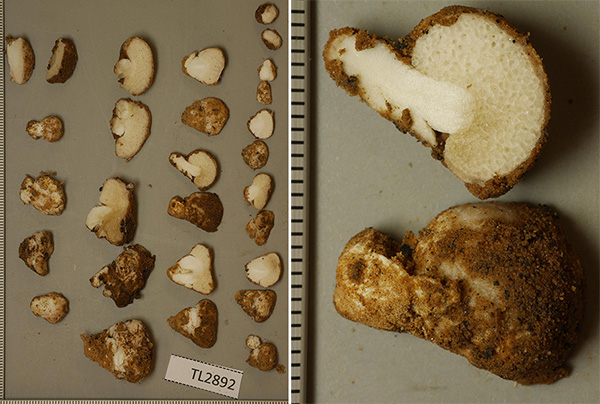
Three specimens of “Amylotrama”. Photo: D. Catcheside.

In 2017, the main foci of the annual survey of fungi on Kangaroo Island (22-29 June 2017) were not only on continuing with making lists of fungi at the different sites visited, but also on disc fungi, truffles and truffle-like fungi (2.6mb PDF) on collecting data for a project on the evolution of truffles.

The truffle-like Stephanospora (top) and an unknown species from the Cortinariales. Photo: D. Catcheside.

Truffle expert Teresa Lebel (National Herbarium of Victoria) made over fifty collections of truffles, some of which are very likely to be new species. These included three distinct species in the undescribed truffle-like genus “Amylotrama”. One was brightly coloured chrome yellow with red and blue staining, the other two were rather nondescript.

Amongst other interesting finds was a new species of the truffle-like genus Stephanospora and a strange little translucent pearlescent parachute-shaped fruit-body with dark chocolate spore bearing tissue. This last taxon was collected during last year’s survey on Kangaroo Island and preliminary DNA work on this collection gave a hint that it fitted in the Cortinariales. This is a very large order, and further work is needed to narrow down likely affinities.

A new species of truffle-like Amanita (previously known as Torrendia) was close to a species known from Western Australia, Amanita grandis, but does not conform completely to this taxon. It is a very fragile little white fungus, whose fruit-bodies were buried up to 3-4 cm and were very difficult to dig out of the ground intact as the volva and veils were stuck to the encasing soil and broke off easily.

A species of Amantia, possibly related to A. grandis. Photo: D Catcheside.

Four further collections were made for a project investigating the molecular basis of how truffle-like fungi, which fruit underground, have evolved from mushroom-like fungi. In Australia alone, this has happened at least 58 times in different genera over the past few million years.

The truffle-like habit reduces desiccation of fruit bodies and thus increases spore survival in arid conditions. Most such fungi are in a tripartite symbiotic association. They provide trees with water and minerals and small mammals, that find them by smell, with food. In turn the trees supply them with sugars and the small mammals disperse their spores. The genomes of twelve pairs of related fungi, one a truffle the other a mushroom, will be sequenced and the genes active during development of the fruiting body identified.  The project is supported by the US Department of Energy through the Joint Genome Institute and is conducted by an international team of mycologists led by David Catcheside (Flinders University).

Part 1 of this blog article can be accessed here.

Mycologist Teresa Lebel collecting data and specimens for the “truffle project”. Photo D. Catcheside

Contributed by State Herbarium Hon. Associate Pam Catcheside.

New SA plants named after actors

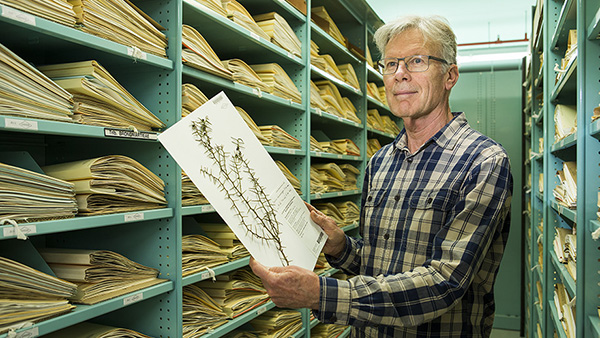
Mike Crisp in the herbarium. Photo: S. Hay (ANU).

Earlier in the year, Australian National University’s Emeritus Prof. Mike Crisp made headlines, when he named two new species of Daviesia (egg and bacon peas) after Danny DeVito and Arnold Schwarzenegger.

The monograph, published in the journal Phytotaxa, is the culmination of over 40 years of research into the genus. It is the first comprehensive account since Bentham‘s treatment in Flora Australiensis (1864), which included 55 species. Crisp and co-authors now recognise 131 species and several subspecies.

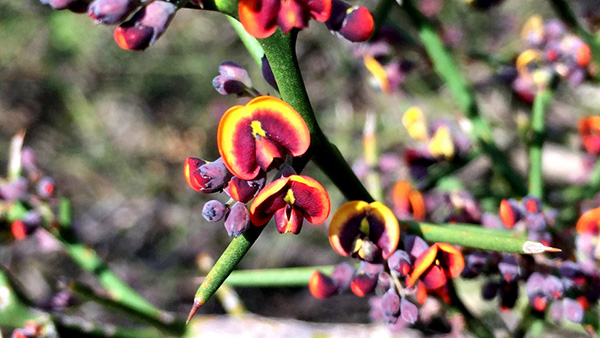
Among the newly described species that occur in South Australia are Daviesia schwarzenegger and D. devito. These have now been added to the South Australian Census of plants, algae & fungi.

While variation with in Daviesia was known for a long time, only modern DNA sequence analyses made the recognition of the two taxa possible, by showing that D. benthamii subsp. humilis comprised two cryptic species that are more closely related to other species than to D. benthamii. The two species were named after the actors, as they are “unlikely twins“, similar to the two characters Schwarzenegger and DeVito play in the movie Twins (1988).

Daviesia Schwarzenegger occurs from the “southern Flinders Ranges in South Australia, through northern Victoria and as far north as Condoblin in New South Wales”. Photo: M. Crisp.

Daviesia schwarzenegger is also named after Arnold Schwarzenegger, in recognition of his “leadership (as governor of California) in pioneering the reduction of carbon emissions, and for advising the Australian government to do the same“. It is the larger and more robust of the two species, whereas D. devito is the less vigorous of the two cryptic species“.

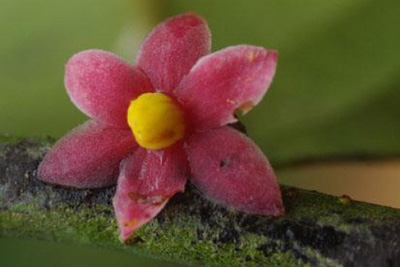
Sirdavidia solannona, a monotypic genus in Annonaceae. Photo: T.L.P. Couvreur (CC-BY).

Watch Mike Crisp talking about the new taxa in this video.

Plants are often named after persons, for example the collector of plant specimens, an explorer or important naturalist. While early botanists also named species after benefactors or royalty, in modern times, celebrities and politicians have been used. Recent examples include: