
Author Archives: Jürgen

New Journal articles: June 2017

The State Herbarium‘s journal was renamed from Journal of the Adelaide Botanic Gardens to Swainsona this year, as we announced a few months ago. The journal’s web-site has now been changed and updated to reflect this name change. It can be accessed using the new web-address flora.sa.gov.au/swainsona.

The Volume numbering will continue. This year, it is planned to publish two volumes of Swainsona: Vol. 30 of the renamed journal will contain the Proceedings of the Botany Symposium at the 2016 NRM Science Conference and will be published later this year. Regular papers are published in Vol. 31.

Papers are published electronically as soon as they are reviewed, edited and typeset. A hardcopy volume is printed at the end of the calendar year or beginning of the next year, collating all articles published during this time. Printed volumes are distributed to botanical libraries around the world and are also available for purchase. The journal is also available through JSTOR.
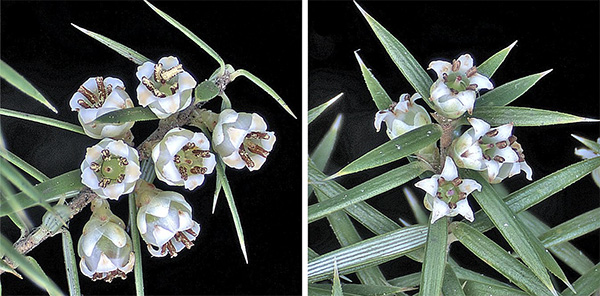
Leptecophylla pogonocalyx subsp. decipiens, a newly described subspecies from Tasmania. Photo: J.A. Jarman.

Today, the State Herbarium published four regular papers in the online version of Vol. 31 of Swainsona.

S.J. Jarman & G. Kantvilas, Leptecophylla in Tasmania: a reassessment of four species. (12.5mb PDF)

In this article, the occurrence of Leptecophylla juniperina in Tasmania is reviewed by two botanist from the Tasmanian Herbarium. Two subspecies of this taxon are re-instated to specific rank and the new combinations published: L. oxycedrus  and L. parvifolia. Leptecophylla juniperina itself is excluded from the Tasmanian flora. Tasmanian plants previously identified as L. juniperina are mostly either L. oxycedrus or the newly described L. pogonocalyx subsp. decipiens. An identification key is provided for Tasmanian species of Leptecophylla.

P.S. Catcheside, S. Qaraghuli & D.E.A. Catcheside, A new species of small black disc fungi, Smardaea australis (Pezizales, Pyronemataceae), is described from Australia. (1.8mb PDF)
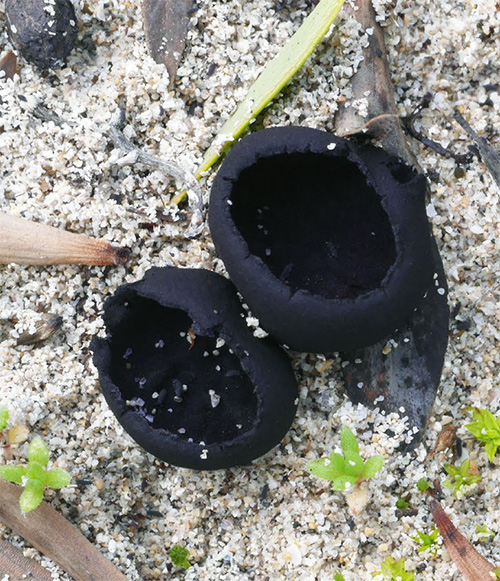
Smardaea australis, a new small black disc fungus from Kangaroo Island. Photo: D.E.A. Catcheside.

The authors from the State Herbarium and Flinders University describe a new species, Smardaea australis. This small black fungus is known from five collections made between 2001 and 2014 in South Australia and one older specimen from Victoria. This is the first record of the genus Smardaea in Australia. The phylogeny of Smardaea and Marcelleina, both genera of violaceous-black discomycetes having similar morphological traits, is also analysed and discussed.

G. Kantvilas & J.A. Elix, Tephromela baudiniana sp. nov. (lichenised Ascomycetes) from Kangaroo Island. (1.5mb PDF)

Lichenologists from the Tasmanian Herbarium and the Australian National University describe a new species of the genus Tephromela, which contains very unusual chemical substances. Many species of the genus are characterised by their metabolites. Alternariol and 9-O-methylalternariol occur very rarely as major metabolites in lichens and are known as such only in the unrelated species Pertusaria praecipua from Papua New Guinea.

G. Kantvilas, Two species of Bacidia De Not. with pruinose apothecia from Kangaroo Island. (2.4mb PDF)
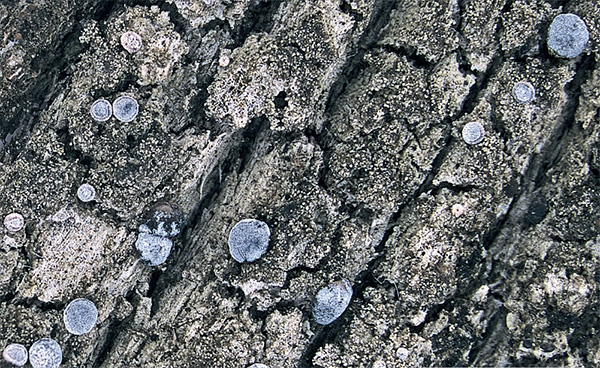
Bacidia brigitteae, a new lichen species from Kangaroo Island. Photo: G. Kantvilas.

The author continues his research on lichens from Kangaroo Island with this paper reviewing two species of Bacidia, one of which is described as new. Both belong to a group in the genus with pruinose apothecia.

To access content of all volumes of Swainsona and the Journal of the Adelaide Botanic Gardens since Vol. 1 (1976), please visit the journal’s web-site at flora.sa.gov.au/swainsona.
New article in The Conversation

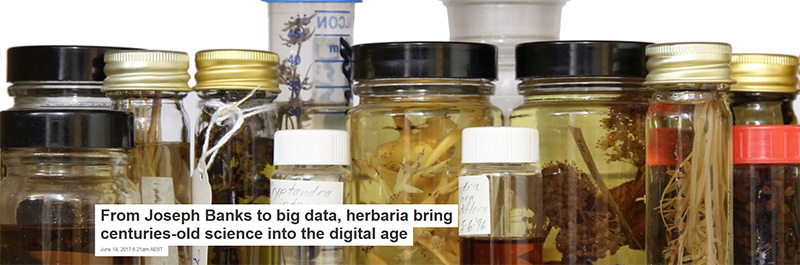
State Herbarium of South Australia‘s Chief Botanist Michelle Waycott wrote an article for the online news portal The Conversation that was published today. In the article entitled “From Joseph Banks to big data, herbaria bring centuries-old science into the digital age” Michelle discusses herbaria and history, plant specimens and types, taxonomy and nomenclature, the Australasian Virtual Herbarium, molecular research and much more.

Landline report features the Herbarium

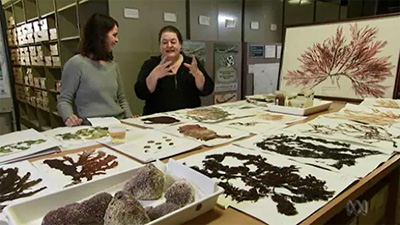
On Monday, a report on ABC television’s Landline program on the potential for a seaweed industry in South Australia features an interview with Chief Botanist Michelle Waycott and several shots from the vaults of the State Herbarium of South Australia. A new document to the State Government recommends a multi-million dollar investment into a seaweed industry.

See Michelle and the Herbarium at 2:20, 9:50, 11:10 and 19:30 mins.

Plant of the Month: June 2017

Bryobartramia novae-valesiae and other strange beasts!
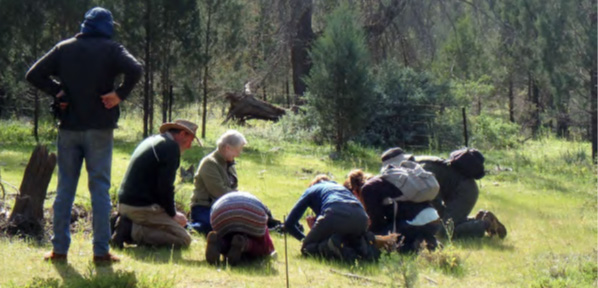
In August 2016, an arguably slightly eccentric group of people gathered in South Australia for the 13th Australian Bryophyte Workshop. These are regular gatherings of a small and scattered group of people from Australia (and sometimes beyond) who are interested in bryophytes: the mosses, liverworts and hornworts. Whilst a lot of people would associate these small plants with wetter areas, many bryophytes can also be found in more arid areas. This time the Workshop was organised by State Herbarium botanist Graham Bell, and was based at Pichi Richi Park in the Flinders Ranges. One of the main field sites was in Mount Remarkable National Park, this month’s Park of the Month.

Bryophyte workshop participants during fieldwork. Photo: G. Bell.

An occupational hazard of working with dry area bryophytes is the amount of time spent on hands and knees…

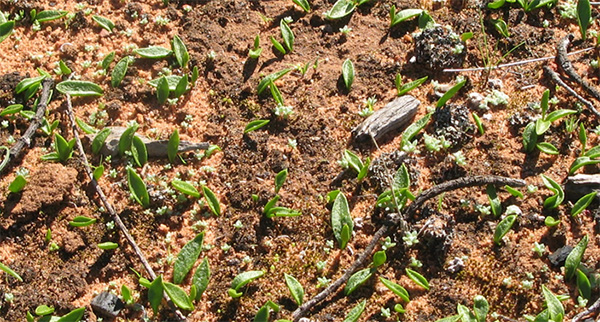
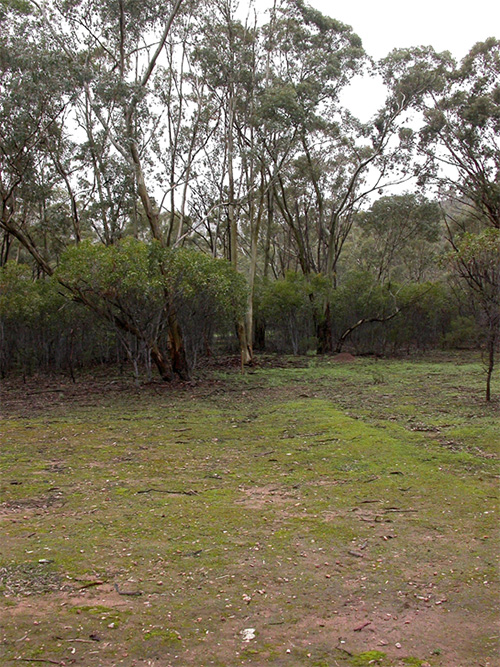
Habitat of Bryobartramia. Photo: D.E.A. Catcheside.

Fortunately the season had been exceptionally good, resulting in fine populations of bryophytes being observed. Some of these plants are ephemeral, only appearing in wet seasons and then surviving by means of the spores they produce. Bryobartramia novae-valesiae (G.Roth) I.G.Stone & G.A.M.Scott (no common names here, I’m afraid!) is one of these tiny ephemeral plants, and has rarely been collected in South Australia (Flora of Australia description, 134kb PDF). In fact, only one specimen from SA was previously identified in the State Herbarium collection, and only three others are to be found in other herbaria. This doesn’t necessarily mean that the plant is that rare — just that no-one with the right “eyes” has gone looking in the right places at the right time!

Graham Bell found the Bryobartramia on bare patches of clay soil near Alligator Gorge, together with a number of other tiny bryophytes.

Bryobartramia movae-valesiae, line drawing from D.G. Catcheside, Mosses of South Australia (1980).

Only two species of Bryobartramia are currently recognised in the world. They occur in Australia and southern Africa. Bryobartramia is easily distinguished from other mosses as the spore-producing capsule is completely covered by a balloon-like enlarged calyptra – this is normally lost early in the development of the spore capsule.

For something just a little larger, a wonderful population of the tiny fern Ophioglossum lusitanicum L. was also observed during a reconnaissance trip before the Workshop. This plant is not often seen, as it is an annual fern, which only reaches about 2–3 cm in height, each plant usually producing just one semi-succulent leaf. Like Bryobartramia, it lives only long enough to produce spores, which are able to produce new plants in the next wet season. Ophioglossum, like other ancient and primitive ferns and bryophytes, is also found in many other parts of the world.

Ophioglossum lusitanicum at The Battery, Mt Remarkable Natl. Park. Photo: D.E.A. Catcheside.

Ophioglossum lusitanicum showing young spore capsules. Photo: D.E.A. Catcheside.

Ophioglossum was found on the slopes of The Battery, on the western side of Mount Remarkable National Park.

This area has not been visited by many botanists, especially those working on fungi and bryophytes. Pam Catcheside, Honorary Research Associate and mycologist at the State Herbarium, who accompanied Graham Bell on this trip, found several unusual or little-collected fungi here.

On the summit of The Battery was found the fifth collection from South Australia (and only the sixth specimen ever known) of a new species of Smardaea, a small black disc fungus which grows on the sandy soil surface. This species is about to be published as new to science.


A new species of the tiny black fungus Smardaea. Photo: D.E.A. Catcheside.


Time travel with the Herbarium through newspapers

Plant presses over time. H.H. Finlayson’s parcel of plants for J.M.Black, 1934 (top). Ray Alcock’s travel press, 1970s (middle). A modern day press with nylon straps and metal mesh for the top and bottom (bottom).

One of the best and time-honoured ways to flatten and dry a plant specimen is to press it between the pages of newspaper — newspaper is durable, absorbent, dries quickly, is easy and cheap to come by and if kept dry lasts a very long time. Botanists have been using newspaper for pressing plants as their technique of choice for hundreds of years and continue to use it to this day (Qld Herbarium brochure, 3.4mb PDF).

Since the State Herbarium of South Australia opened in 1954, hundreds of thousands of plant specimens with their newspaper counterparts have been submitted to the collection (we have over a million specimens in our collection currently). Many specimens were even collected earlier than the official opening.

For example, the State Herbarium has six parcels of plants in its collections that were prepared by H.H. Finlayson in 1934 and identified by botanist John McConnell Black, the author of the first Flora of South Australia. The top photo on the right shows one of the parcels, still in the same condition, as when they were removed from the plant press, and neatly wrapped with twine. We are planning to unwrap them in the near future.

The State Herbarium also cares for artefacts from previous South Australian botanists, such as Ray Alcock’s travel press that he used in the 1970s. Charles Raymond Alcock was one of the State Herbarium’s prolific collectors. He turned his attention to plants, specifically weeds, in the 1950s. Plants and nature conservation became his passion until his death in 2015 (see orbituary in the ASBS Newsletter; 3.6mb PDF).

Ray Alcock’s newspaper clippings.

In most cases, when a plant specimen is filed into the collection it is mounted on archival paper, placed in archival folders and the newspaper originally holding the specimen is thrown away. However, sometimes the newspaper stays with the specimen, for instance there might be excess material that can be sent to other herbaria as duplicates, or it might be a long time between the collection being accepted and it finally being mounted. So naturally, when working with specimens, staff, volunteers and researchers from around the world come across old newspapers and on occasion have been known to take a moment for a good read.

Being natural collectors and curators it is common for herbarium workers to save articles of interest for their own reference or general awareness. For example, Ray Alcock also kept a diary of newspaper clippings.

Here are a few examples of articles found in our Herbarium recently which we would like to share with you, in acknowledgment of History Month. Also to appreciate the inadvertent history held within the State Herbarium of South Australia and no doubt many other herbaria worldwide.

These first few articles are from the Adelaide Advertiser, between 1915 to 1917, some collected by Ray Alcock, focusing on issues such as climate change, agricultural prospects and even recruitment for soldiers in World War 1 (click on the image to enlarge).

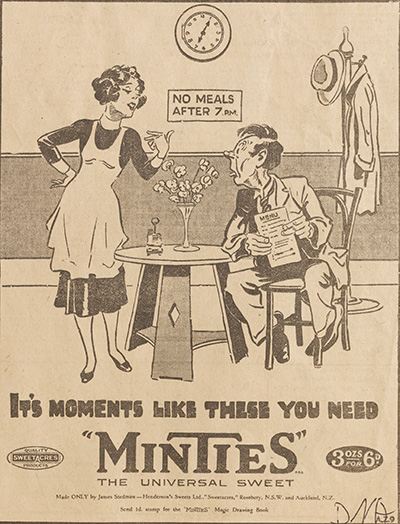
Minties advertisement from The Advertiser, Adelaide, Sat., 30 July 1932.

Prices of fruit and vegetables at Fruitland (aka Foodland) from The Advertiser, Thu., 26 Oct. 1972.

These snapshots allow appreciation of the culture and literature at that time. The snippets also highlight an unusual role of our collections which include herbaria being custodians of many aspects of our history. These insights into the past, random and unintentional, but charming and informative, also make us aware of the important long term nature of collections, such as those in the State Herbarium.

As a resource for plant specimen collectors, the convenience of newspaper these days is becoming problematic, as social media and the internet take over. At times, the State Herbarium has run low on newspaper stock, since less people put them aside and donate. Although this isn’t of critical concern currently, eventually we will need to consider how to process plant pressings in the future.

Contributed by State Herbarium staff Chelsea Novice and Graham Bell.