Author Archives: Jürgen

How many plants are unique to South Australia?

Endemics in SA (Feb. 2014)The answer is 418 … at present. A recent review by State Herbarium botanist Peter Lang reveals that South Australia currently has 418 endemic vascular plant taxa (species, subspecies & varieties): these are native plants that occur naturally nowhere else. Some have a relatively wide distribution that happens to be contained within the State borders, but most are restricted to smaller areas. The number of such endemic taxa changes as new species are described and our knowledge of plant distributions improves.

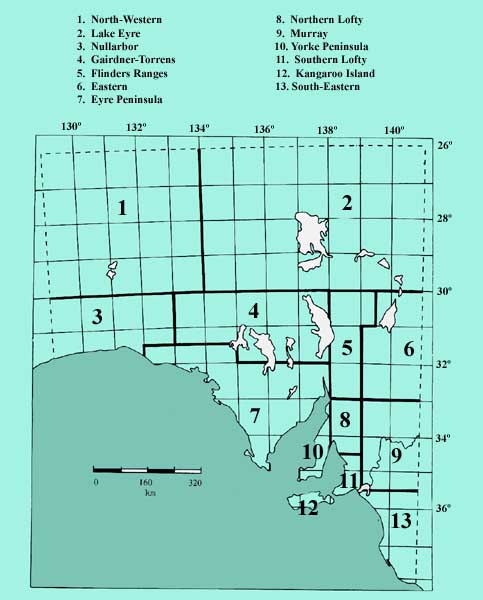
A similar question may be posed for each of the 13 botanical regions (as used by the State Herbarium of South Australia). The chart shows the percentage for taxa that are confined to a single botanical region only. Two regions, Kangaroo Island (KI) and Eyre Peninsula (EP), stand out as having the highest percentage of regionally endemic plants. The presence of mountain ranges and restricted habitats, as well as isolation by sea levels both past and present, appear to promote the development of locally endemic flora.

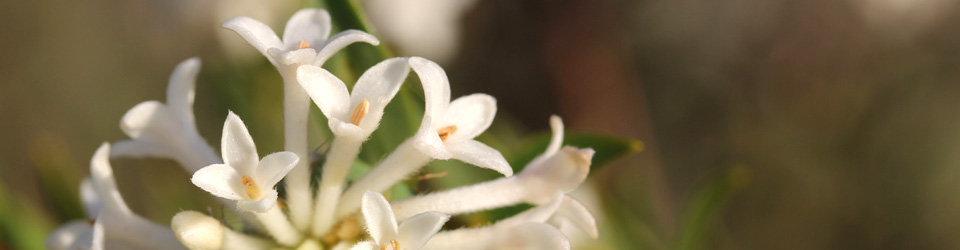
Pictured are examples of two South Australian endemic plants: Anthocercis angustifolia, endemic to the Mt Lofty and Flinders Ranges, and Prostanthera calycina (West Coast Mintbush), endemic to western Eyre Peninsula.
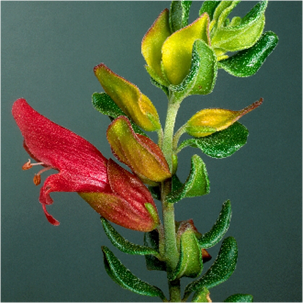
Picture by P.J. Lang

Prostanthera calycina

Photo by P.J. Lang

Anthoceris angustifolia

Life in the pond: Chara

Photo by C.Ricci & B.Baldock, Feb. 2014

Chara globularis stalks and side branches

An interesting green alga, about 100 mm tall, growing on the bottom of the Botanic Garden’s ponds has appeared — it is Chara globularis.

Carolyn Ricci and Bob Baldock from the State Herbarium’s Phycology Unit report that the alga is often found in calcium-rich waters. Its central stalks are ribbed with cells that accumulate lime crystals, and there are rings of stiff side branches ending in points.

Photo by C.Ricci & B.Baldock, Feb. 2014

Chara globularis, close-up

The female organs are bottle-shaped, wrapped in five twisted cells and stoppered with a cellular plug. Male organs in this species are spherical, lurk just beneath the females and are orange.

Who said that algae are simple life forms?

New Journal article, Feb. 2014

Today, 18 Feb. 2014, the first paper of Vol. 27 (2014) was published in the online edition of the Journal of the Adelaide Botanic Gardens.

Placynthium australiense sp. nov. (lichenised Ascomycota, Placynthiaceae) from South Australia
by P.M. McCarthy & G. Kantvilas
describes a new species of lichen from the Murray River region of South Australia.

To access content of all volumes of the Journal of the Adelaide Botanic Gardens since 1976, please visit the journal’s web-site at flora.sa.gov.au/jabg.

Illustraion by Pat McCarthy

Placynthium australiense

Interesting algae in the lake

Image by Bob Baldock, Feb. 2014

Botryococcus braunii

This photograph shows a microscopic image of Botryococcus braunii.  Hon. Research Associate Bob Baldock reports that this interesting algae has appeared within floating rafts of filamentous green algae (mainly Oedogonium sp.) in the storagepond of the new Adelaide Botanic Gardens’ First Creek Wetland.

Botryococcus braunii grows as a colony of egg-shaped cells within a tough, gelatinous sheath: individual colonies may cling together by gelatinous strands. Although a member of the green algae, it, and its colonial matrix are usually coloured yellow or brown.  Individual cells store oil droplets, and this feature is currently being researched as a possible source of bio-fuel. — But don’t worry, there is insufficient to set the pond alight!

Bob Baldock is a long-time associate of the State Herbarium of South Australia, responsible for the creation of the Algae Revealed fact-sheet series on marine algae of southern Australia.