Please note that the next It’s all about the plants seminar has been postponed to
Tue., 16 June 2014 (10am).
Presenter will be Dr Teresa Lebel, Senior Mycologist at the National Herbarium of Victoria, Royal Botanic Gardens, Melbourne.

Please note that the next It’s all about the plants seminar has been postponed to
Tue., 16 June 2014 (10am).
Presenter will be Dr Teresa Lebel, Senior Mycologist at the National Herbarium of Victoria, Royal Botanic Gardens, Melbourne.
State Herbarium Hon. Research Associate Bob Baldock reports on the following two images.
They depict not a sea shell, or a coral, but a red coralline alga — no more than 2 mm tall! It was found scattered on the fine branches of a brown alga, Cystophora (2.6MB Algae Revealed fact-sheet) from 20 m deep at Pearson Island, off Ceduna, by the Marine Park Monitoring Group in March 2015.  Finding a name for it is proving difficult. It doesn’t fit exactly into diagnostic features of known species. The closest match that has been suggested is Hydrolithon farinosum (link to species entry in the online version of H.B.S. Womersley‘s Marine benthic flora of southern Australia).
Last week, the Adelaide Mt Lofty Ranges NRM Board (AMLR NRM) released a Fungi of the Adelaide Hills identification chart (1.8MB PDF). It was published in collaboration with the Adelaide Fungi Study Group, which is lead by State Herbarium Hon. Research Associate Pam Catcheside (and associated with the Fields Naturalists Society of South Australia).

This is one of a number of fact sheets on local flora and fauna, published by AMLR NRM. The news was reported by the Adelaide Advertiser today (25 May 2015, p. 5) and also posted on the Advertiser’s web-site, as well as The Australian‘s web-site.
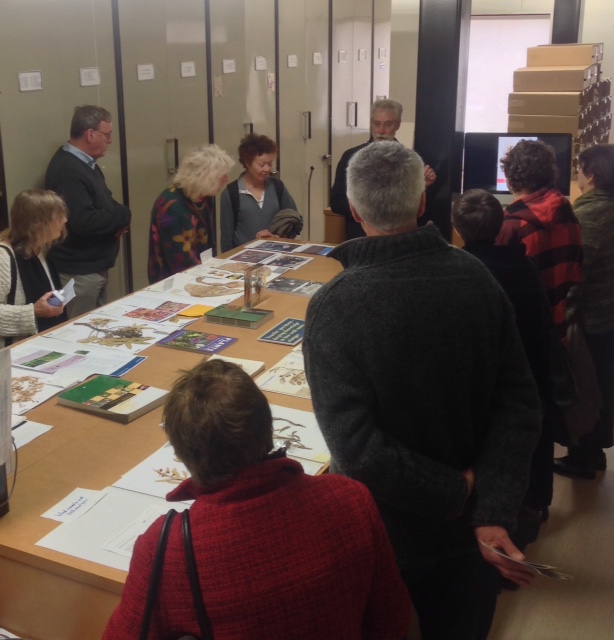
On the weekend of 9 & 10 May 2015, the State Herbarium of South Australia was open to the public as part of the About Time: South Australia’s History Festival. This is the fourth year that the State Herbarium has participated in South Australia’s History Month events.
 Over 60 people booked to come on four guided tours, held by Herbarium Manager Peter Canty and several staff members. Visitors learned about the history of the old trambarn building (1.1MB PDF brochure) and the Municipal Tramways Trust, and the history and work of the State Herbarium. The groups were also shown examples of specimens from the Herbarium, which did not only include pressed plants, but also algae, fungi, mosses and lichens, and saw some of the published outcomes of the Herbarium’s work.
 Australia’s Virtual Herbarium (AVH) provides access to the plant specimen data held by Australian herbaria, enabling detailled mapping of plant distributions. Last week, the new version of AVH was released. It comes with significant interface improvements, additional querying capabilities and a new design that also works well on small screens and portable devices. Please read the AVH News item for more information.
AVH is an initiative of the Council of Heads of Australasian Herbaria and pools the collection data of about 7 million specimens from Australia’s major herbaria, data for over 5 mio of these is already available online.
You must be logged in to post a comment.