New Flora chapters published, June 2014

Photo by T.M. Jaques

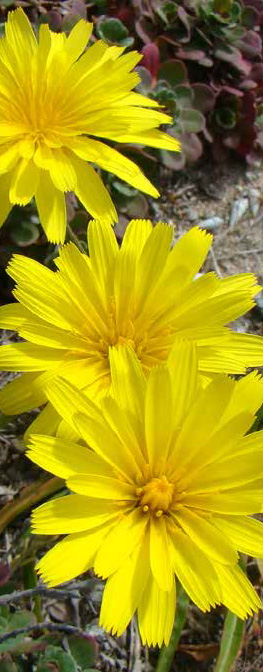
Microseris lanceolata, native yam daisy

Two chapters of the new, 5th edition of Flora of South Australia were published today, 10 June 2014.

Asteraceae (partly) (6.2mb). This chapter contains treatments of the tribes Cardueae, Cichorieae (formerly called Lactuceae), Helenieae and Tageteae. Over 60, mainly naturalised species of daisies in 30 genera are described by five botanists from Australia and New Zealand: Tony Bean, David Cooke, Avi Holzapfel, Neville Scarlett & Ian Thompson. Further tribes of Asteraceae are in preparation and an update will be published once they are finalised. Some species are illustrated with line-drawings or photographs.

Convolvulaceae (version 2) (2.8 mb). State Herbarium botanists Robyn Barker & Peter Lang have up-dated the treatment by the late Bob Johnson. The family is repesented in South Australia with 36 species in 10 genera. Five photographic plates with colour images of many species were also added to this Flora chapter.

Previous versions of Flora treatments are still available from our Superseded treatments page. The general link to the 5th edition of Flora of South Australia is flora.sa.gov.au/ed5.

New Journal article, May 2014

Today, a short paper (118kb PDF) by Rafaël Govaerts (Royal Botanic Gardens, Kew, U.K.) was published in the online edition of the Journal of the Adelaide Botanic Gardens, correcting the nomenclature of the Philip Island wheat grass.  This species is endemic to Philip Island and Norfolk Island in the Pacific Ocean (over 1400 km east of mainland Australia), and Lord Howe Island (c. 600 km east of Australia).  More information on the vegetation of Philip Island can be found in a report by Kevin Mills (2.7mb PDF).

To access content of all volumes of the Journal of the Adelaide Botanic Gardens since 1976, please visit the journal’s web-site at flora.sa.gov.au/jabg.

Photo by Dr Blofeld (WikiPedia)

Philip Island, 6 km south of Norfolk Island

No seminar in June

Spyridium halmaturinum, photo by F. UdovicicPlease note that the It’s All About the Plants seminar for next week has been cancelled.  To be advised of the topic of the next session, please subscribe to this BLOG.  It is scheduled for 1 July 2014.

Journal hardcopy printed, Vol. 26 (2013)

Hardcopy of Vol. 26 of the Journal of the Adelaide Botanic Gardens is now available. The volume has 105 pages and contains all eight papers that were published online during 2013. The Journal is now using the latest digital printing techniques, with many photographs, line drawings and one watercolour plate reproduced in full colour.

Copies can be purchased for $25 from the Reception, Adelaide Botanic Gardens, Goodman Building, Hackney Road, Adelaide, or by phoning 08 8222 9311. Copies to our subscribers are currently being posted.

Please visit flora.sa.gov.au/jabg for the online version of the Journal, including contents for Vol. 26 and access to all back issues from Vol. 1 (1976).

Two new bladderworts for South Australia

State Herbarium botanist Peter Lang reports that two recently described species of bladderwort  (Utricularia) have been added to the Census of South Australian plants, algae & fungi. Bladderworts are carnivorous plants that have leaves modified to form small bladder-like traps.

Utricularia fenshamii is remarkable in being almost entirely confined to mound springs of the Lake Eyre Basin, and in South Australia is only found on such springs just beyond the northern edge of the Flinders Ranges.

Utricularia barkeri was named after Bill Barker, Honorary Associate and former Chief Botanist at the State Herbarium, who had made annotations on herbarium sheets in the mid 1980s to indicate differences from the more common U. dichotoma, with which it often grows.  In South Australia it is found in the South-Eastern and Kangaroo Island regions.

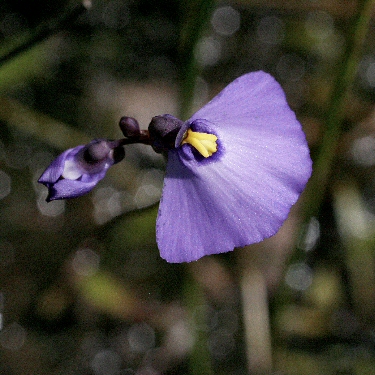
The photos show flowers of Utricularia fenshamii (top image) compared to the more common U. dichotoma (bottom), in which it was previously included.

Utricularia fenshamii (Photo by SA Seed Conservation Centre)

Utricularia dichotoma (Photo by P.J. Lang)