Author Archives: Jürgen

Cactus book launched

IMG_8551 edit crop (small)

Bob Chinnock during the book launch

On Friday evening, 19 June 2015, Bob Chinnock‘s new book on weedy opuntioid cacti was launched by Michelle Waycott, State Herbarium of South Australia, and John Virtue, Manager NRM Biosecurity. Over 30 colleagues and friends of Bob gathered to celebrate this achievement.

Feral opuntioid cacti of Australia is published in two parts. The first part, covering the cylindrical stemmed genera Austrocylindropuntia, Cylindropuntia and Corynopuntia is now available. The book includes many colour photos, detailed line-drawings and descriptions of the cacti’s stems, fruit and flowers, as well as information on suitable controls and the occupational health and safety issues associated with dealing with them. The second part, containing the flat stemmed genus Opuntia (incl. Nopalea), is currently in preparation.

More information on the book and how to purchase it can be found on the following web-page: know.ourplants.org/cacti/.
IMG_8565 edit (small)

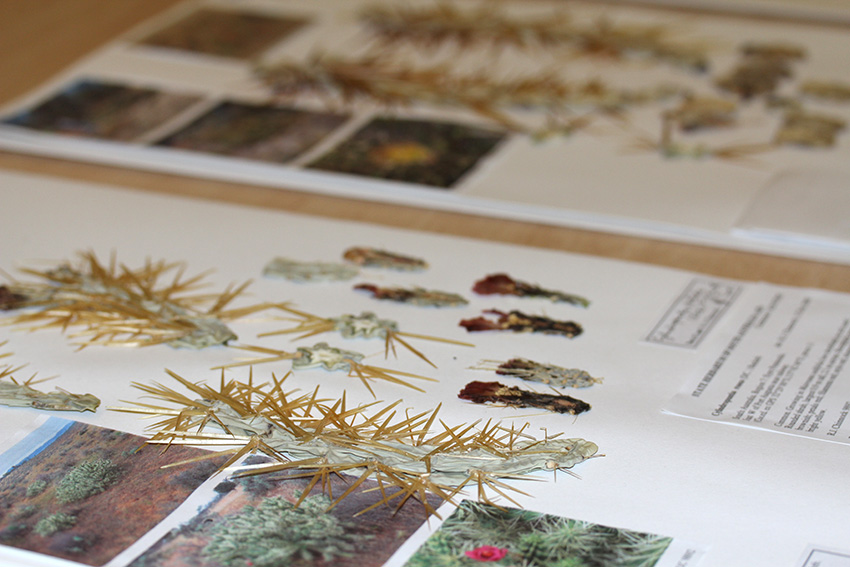
Herbarium specimens of opuntioid cacti on display during the book launch, Cylindropuntia pallida in foreground (formerly C. rosea)

From snow melt to seashore: fungal tales from the land of the long white cloud

It’s All About the Plants
Tuesday, 16 June 2015, 10:00–12:00
Ground Floor Meeting Room / Tea-room,
State Herbarium of South Australia,
Old Tram Barn Building, Hackney Road

by Teresa Lebel
Senior Mycologist , National Herbarium of Victoria, Royal Botanic Gardens, Melbourne

I have just returned from a two year fellowship in New Zealand, where I was fortunate to be able to work on a series of different projects and travel quite a bit around the islands. New Zealand has an amazing range of ecological zones and a diverse plant flora (including many introduced species), all of which provide an array of substrates and hosts for fungi. While my particular research interests are focused on the taxonomy and phylogenetic relationships of truffles and truffle-like fungi, I am also intrigued by interactions between fungi and other organisms, whether positive or negative, or in balance. In this talk I will provide snapshots of a series of fungal projects; and every completed project generates many more questions!

All Herbarium staff, honoraries, volunteers, students and guests welcome.
Morning tea provided.

Life in the sea: Miniscule and mysterious

State Herbarium Hon. Research Associate Bob Baldock reports on the following two images.

They depict not a sea shell, or a coral, but a red coralline alga — no more than 2 mm tall! It was found scattered on the fine branches of a brown alga, Cystophora (2.6MB Algae Revealed fact-sheet) from 20 m deep at Pearson Island, off Ceduna, by the Marine Park Monitoring Group in March 2015. Finding a name for it is proving difficult. It doesn’t fit exactly into diagnostic features of known species. The closest match that has been suggested is Hydrolithon farinosum (link to species entry in the online version of H.B.S. Womersley‘s Marine benthic flora of southern Australia).

Continue reading

New fungi guide for the Hills

Last week, the Adelaide Mt Lofty Ranges NRM Board (AMLR NRM) released a Fungi of the Adelaide Hills identification chart (1.8MB PDF). It was published in collaboration with the Adelaide Fungi Study Group, which is lead by State Herbarium Hon. Research Associate Pam Catcheside (and associated with the Fields Naturalists Society of South Australia).

AMLR Fungi Adelaide Hills (small)

This is one of a number of fact sheets on local flora and fauna, published by AMLR NRM. The news was reported by the Adelaide Advertiser today (25 May 2015, p. 5) and also posted on the Advertiser’s web-site, as well as The Australian‘s web-site.