The next 10 years — a new vision for taxonomy and biosystematics in Australia and New Zealand

It is so exciting!! Last Friday (27 April) we launched “Discovering Biodiversity—a decadal plan for taxonomy and biosystematics in Australia and New Zealand 2018–2027”. A small group of South Australians joined around 50 others to attend the launch at Parliament House in Canberra and a follow-up meeting to discuss the future implementation of the plan at The Shine Dome.
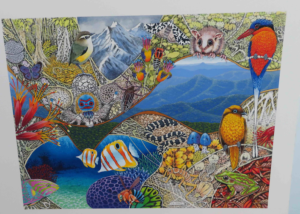
Artwork Decadal Plan by David Stacey

Since late 2012 dedicated and committed people from Australia and New Zealand worked together to get the plan underway. Following a grass-roots startup, we are fortunate that in last 18 months Kevin Thiele has coordinated a wide range of engagement and consultation. Teleconferences, online discussions, workshops at conferences and online writing sessions were held. Kevin also launched a taxonomy blog site noto|biotica, through which some big ideas, concepts and discussion was facilitated. Supported by the Working Group and an Advisory Committee the generation of the plan was highly collaborative and yet benefited from the unified voice Kevin gave the overall process.

Kevin was a champion at getting us to all share ideas, opinions and also to listen and convey to the community of ideas and to form a biosystematics community driven mission for the next decade. The professionalism of the Australian Academy of Science and the New Zealand Royal Society Te Apārangi, helped elevate the decadal plan Discovering Biodiversity to give us all a chance to see a way forward. The plan covers biodiversity from the bottom of the ocean to the tops of the mountains and will pave the way for coordination of new initiatives and to consolidate the immense body of work we already deliver…

I want to encourage everyone to read the plan, and also to enjoy the document itself, a great visual piece of work and well illustrated with images of the biodiversity of Australia and New Zealand! Also enjoy the artwork commissioned for the cover, Abundance by David Stacey. [Download full resolution (19MB) or smaller version (4.2MB)]. The forward by David Attenborough emphasises not only the role of taxonomy and biosystematics but the importance of recognising and valuing our biodiversity…

Also checkout the short video with David Attenborough to grab your interest!

Contributed by Michelle Waycott

Mentoring artists: Rebecca McEwan

During the month of March, I was fortunate to spend time at the State Herbarium with the support of the Guildhouse LimberUp mentorship program. Supporting South Australian Artists, Guildhouse enables artists to access opportunities and make connections with the broader community to support their practice. Through the LimberUp program I identified a valuable opportunity to engage with the State Herbarium to support the current themes in my work.

Rebecca mounting specimens onto herbarium sheets. Photo: R. McEwan.

Over the last few years my art practice has referenced my strong interest in plants at both a macroscopic and microscopic level. Concurrently my art practice has explored the relationship humans have created with bees and our dependence on them to maintain balance within our ecosystem.

The intent of this mentorship was to engage with and observe the unique and specialised environment of the State Herbarium. During the mentorship I observed processes involved in the “exemplar project”, i.e. classifying and curating pollen specimens to develop a pollen library for South Australia’s entire flowering plant flora, the first of its kind in Australia.

This clinical study directly linked to the ongoing theme of bees and their essential role in pollination in my studio practice. During my time at the Herbarium I had the opportunity to observe and partake in microscopy, specimen handling and processing, scientific observation and documentation undertaken as part of the project.

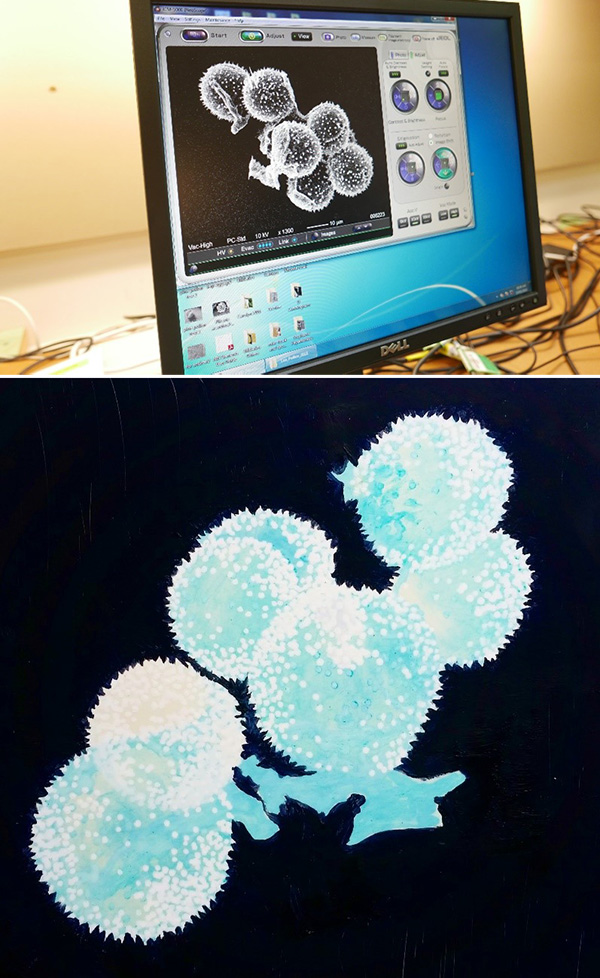
Pollen grains on the screen of the SEM (top) and artwork based on the SEM of pollen images (bottom). Photo & artwork: Rebecca McEwan.

The time with the SEM was invaluable. Previously only being able to see these images online, the opportunity to view the images in real time and manipulate them to gain a 3D perspective was fascinating and enabled me to gain a greater understanding of the pollen’s characteristics. It has allowed me to see and understand the process from specimen collection to preparation for microscopic viewing. One of the unexpected fascinating aspects has been the need for the minute pollen grains to be finely coated in platinum to create a more detailed image in the SEM.

Pollen samples for the “exemplar project”. Photo: Rebecca McEwan.

Having now commenced a 3-month artist-in-residence program at Sauerbier House in Port Noarlunga exploring the history of beekeeping within the Onkaparinga region and the role bees have played in viticulture and almond production I am able to reference the rich visual catalogue of shape, form and texture gained at the State Herbarium.

I have found this Guildhouse LimberUp mentorship program to be enriching and refreshing. The staff were extremely supportive of my endeavours and brimming with information I would not have been able to source any other way. The opportunity to be exposed to an environment which lives and breathes the themes of my art practice was very fulfilling.

I am very grateful to Professor Michelle Waycott, Peter Canty, and Carolyn Ricci and also the undergraduate Lee, and the many volunteers at the State Herbarium for making this such a valuable experience.

Pencil drawing by Rebecca McEwan. Photo by the artist.

Contributed by Rebecca McEwan (www.rebeccamcewan.com).


Five new journal articles: Apr. 2018

Today, the State Herbarium of South Australia published three articles in the online version of Vol. 30 of Swainsona and two other papers in Vol. 31.

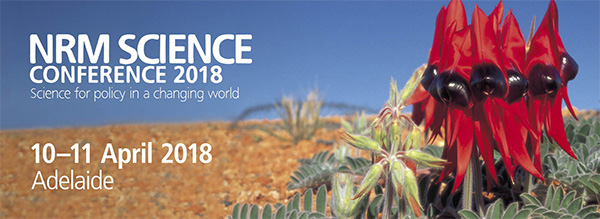
Vol. 30 of Swainsona is the first volume of our journal under its new name. It is a special issue containing the Proceedings of the Botany Symposium at the 2016 NRM Science Conference., celebrating the 60th anniversary of the State Herbarium. More information on the conference and videos of the presentations can be found online.

To co-incide with this year’s NRM Science Conference, the State Herbarium publishes the first three article of the Proceedings of the Botany Symposium, which was entitled Botany 2016 — Past, present and future.

(1) H.B. Cross, E. Biffin & M. Waycott, The Sturt pea through 300 years of Australian botanical exploration (1.3mb PDF).

The introductory paper to the special volume examines the history of research on South Australia’s floral emblem, the Sturt pea, from the species’ first description to the latest Next Generation Sequencing techniques.

(2) R.S. Hill, M.A. Tarran, K.E. Hill & Y.K. Beer, The vegetation history of South Australia (2.1mb PDF)

Hill and co-authors review the fossil evidence for plant life in South Australia though time, in the context of latest research and discoveries, noting the role that fire may have played in the development of the Australian flora.

(3) G. Kantvilas, South Australian lichens — A Kangaroo Island case study (3.3mb PDF)

The author reports on his long-term study of the lichens of Kangaroo Island, outlines the major vegetation types that lichens occur in and their threats, like clearing and fragmentation of habitat. He also discusses two remarkable lichens occurring on the island.

Vol. 31 of Swainsona contains the following new regular papers:

(4) A.S. George, The type of Sturt pea found (0.7mb PDF)

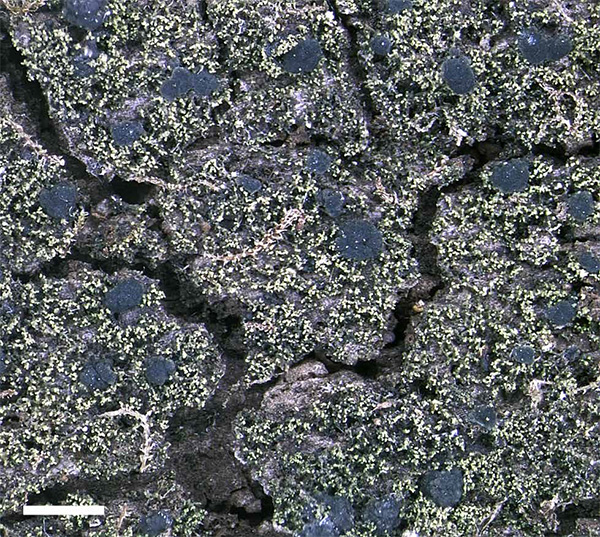
Micarea kartana, a new lichen species from Kangaroo Island. Photo: J. Jarman.

For many years, the type collection of Sturt pea was thought to be lost. George reports the rediscovery of the specimen and corrects the collection locality of the type, the specimen that was used to describe the species.

(5) G. Kantvilas, Micarea kartana sp. nov. (lichenised Ascomycetes) from Kangaroo Island, South Australia
(0.7mb PDF)

Continuing his research on Kangaroo Island lichens, Kantvilas describes a new species from moist log of rotting eucalypt in dry sclerophyll forest.

To access content of all volumes of Swainsona and the Journal of the Adelaide Botanic Gardens since Vol. 1 (1976), please visit the journal’s web-site at flora.sa.gov.au/swainsona.


Artist Lilian Cooper visiting the State Herbarium

Lilan in her temporary studio. Photo: Elisabeth Schelvis.

As a result of a chance meeting two years ago with Carolyn Ricci at the State Herbarium of South Australia in the Adelaide Botanic Gardens, I was introduced to the world of algae. This was one of those fortuitous occasions when meeting someone so impassioned by her subject had an equal reaction on myself. For the last two years I have developed a fascination for algae and seaweed in particular.

I suspect as an artist I approach the subject matter from a different viewpoint than the majority of scientists. My focus is form, composition, the internal structure and the colours of the plants. At all microscopic levels seaweed proves to be fascinating. Carolyn had mentioned in passing that if I found seaweed interesting on a one to one scale then I really needed to see it closer under the microscope and she was entirely correct.

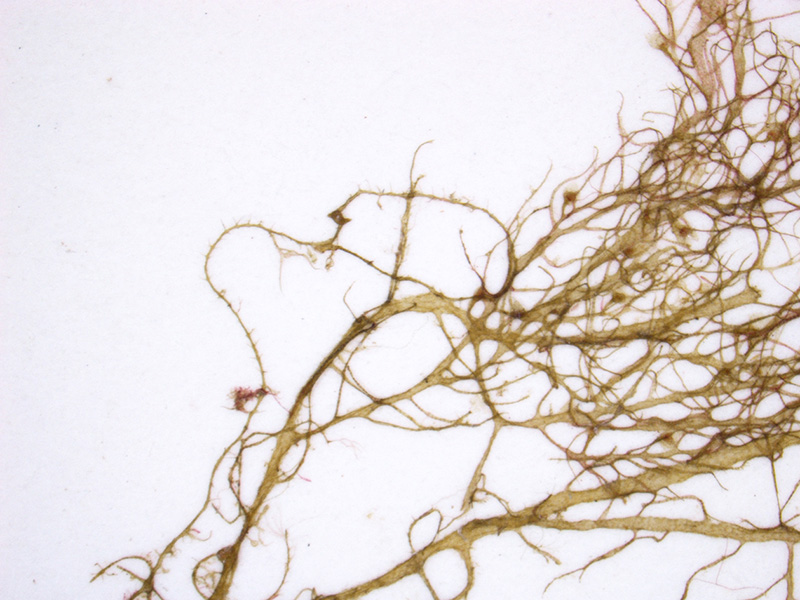
Close-up of the red alga Bonnemaisonia. Photo: Lilian Cooper from material stored at the State Herbarium.

Creatively it was one of the most productive days, I felt like I merely dipped into the subject matter and there is so much I would like to learn and explore. The more I see the more I look forward to further study. It was a privilege to have the laboratory time, the opportunity to use the microscopes and to see and handle some of the extraordinary plant specimens in the collection.

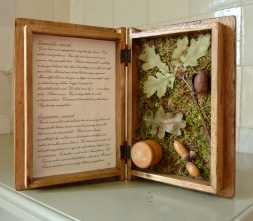
A “wooden book” prepared by von Schlümbach. Photo: Kasteel Groeneveld, The Netherlands.

Presently I work as the visiting artist to Hortus Botanicus Leiden in the Netherlands. I am researching a project on the life and death of trees, this involves me working with researchers from various institutes on the latest tree diseases as well as creating portraits of individual trees. The work is collated in a contemporary xylotheque, reflecting an original xylotheque created by Friedrich Alexander von Schlümbach of Nuremberg in 1790 especially for the university of Leiden. It was commissioned by Louis Napoleon and presented in 1809 as the very latest scientific knowledge (click here and here to see some examples of the parts and contents of a “wooden book”). I am working in turn with contemporary scientific research to create a project that reflects the artistic qualities of our latest technology. My work creates a bridge between the work of specialists in their field and the general public. I aim to make it more accessible appealing to the aesthetic.

The opportunity I have had to spend time in Adelaide has been a privilege. I want to develop the algae project into a substantial body of work exploring the beauty and internal form of the plants. Learning about the herbarium collection has been like entering a box of delights that continually opens to show more and more aspects of plants that I either did not know or had never seen in that way before. I want to heartily thank the Herbarium for letting me visit, for guiding me through the collection and for their warm welcome.

Contributed by Lilian Cooper (www.liliancooper.com).

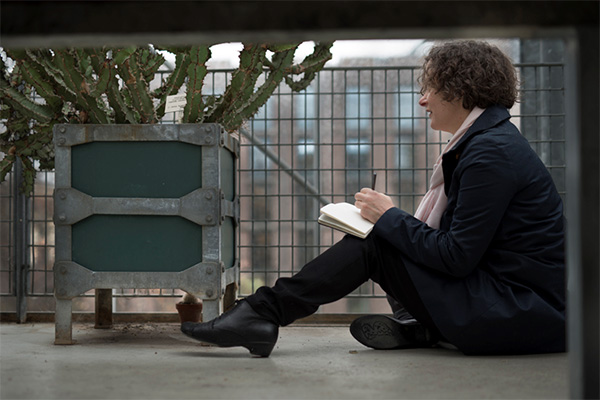
Lilan Cooper sketching a succulent in Leiden. Photo: Elisabeth Schelvis.