Stroll around a palaeolake in a New Zealand sub-tropical rainforest

It’s All About the Plants
Tuesday, 4 February 2014—10:00–12:00
Goodman Building Lecture Theatre

by Dr John Conran (Associate Head of School)
School of Earth and Environmental Sciences, The University of Adelaide

The flora surrounding the early Miocene (23 Ma) Foulden Maar palaeolake included a highly diverse Lauraceae-dominated rainforest with macro- and/or microfossils of now extinct species of epiphytic ferns, a wide range of gymnosperms, 10 species of Lauraceae, and numerous other angiosperms typical of present-day New Zealand ecosystems, including diverse monocots. The macrofossils include leaves, flowers, fruits and seeds and in several cases are sufficiently detailed to allow placement onto cladograms with putative modern relatives, improving the phylogenetic significance of the fossils and their utility for dating evolutionary trees (e.g. Fuchsia, Laurelia, Luzuriaga). Comparisons with the ecology of modern relatives to the fossils at the site suggest that the forest included canopy trees, understorey shrubs, epiphytes, mistletoes, ferns, and vines, as well as forest margin pioneers and emergent aquatic macrophytes. The rainforest supported a mixture of wind-, bird- and insect-pollinated species, as well as both animal- and wind-dispersed fruit and seed types.
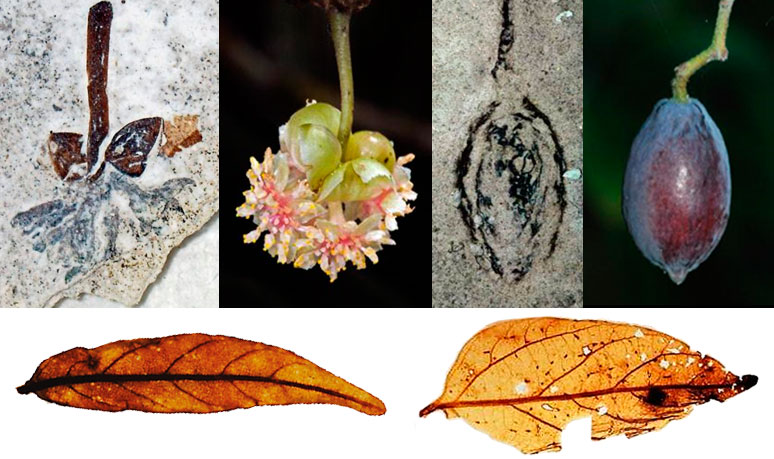
Foulden Flora

Foulden Flora

The palaeoforest most closely resembled a warm temperate to subtropical notophyll vine forest, but was comprised of what are now Australian, New Zealand, South American and New Caledonian elements. CLAMP (Climate Leaf Analysis Multivariate Programme) analysis of fossil leaf morphology at the site also suggests that SE Queensland rainforests are the nearest living climatic proxy. Apparent differences between the in situ macrofossils and the microfossils can be explained partly in terms of local versus regional scales, as well as variation in the soils and underlying geology surrounding the maar. The possible ecology, climate and habitats at the palaeolake and their implications are discussed in terms of the diversity and uniformity of mid-latitude southern New Zealand at the Oligocene–Miocene boundary.

All Herbarium staff, honoraries, volunteers and students are welcome.
Morning tea provided.

[cite as: Southern New Zealand at the Oligocene–Miocene boundary: floristic and palaeoecological characterisation of Foulden Maar.
John G. Conran1, Daphne E. Lee2, Jennifer M. Bannister3 and Dallas C. Mildenhall4
1ACEBB & SGC, School of Earth & Environmental Sciences DX 650 312, The University of Adelaide, SA 5005 Australia; 2Department of Geology, University of Otago, PO Box 56, Dunedin; 3Department of Botany, University of Otago, PO Box 56, Dunedin; 4GNS Science, PO Box 30368, Lower Hutt]

Christmas greetings

Spitzingsee in the Bavarian Alps, Germany

The State Herbarium of South Australia wishes all its friends, volunteers and Hon. Associates a happy Christmas break and all the best for the New Year.  We hope to see you all again in 2014.

Seminar dates for 2014

Spyridium halmaturinum

The State Herbarium of South Australia’s seminar series It’s all about the plants will continue next year. The talks will again take place in the Botanic Garden’s Goodman Building Lecture Theatre (Hackney Road, Adelaide) on the first Tuesday of every month, except January and December, from 10:00–12:00.

The dates for 2014 are:
4 February, 4 March, 1 April, 6 May, 3 June, 1 July, 5 August, 7 October and 4 November.

Topics will be announced on this BLOG about two weeks before a seminar takes place, so stay tuned (and subscribe to get updates). All Herbarium staff, honoraries, volunteers and students are welcome.

Fruit salad at the Museum

Rotgestreifte Gewürz Reinette

Recently, a new book was published, documenting the historical collection of fruit models in the Museum of Economic Botany, Adelaide Botanic Gardens. The Museum holds one of the most complete collection of apples, pears and stone-fruit (plums and apricots) manufactured by Heinrich Arnoldi & Co. in Germany.

Kanellos, T. (2013). Imitation of life — a visual catalogue of the 19th century fruit models in the Santos Museum of Economic Botany in the Adelaide Botanic Garden: a collection of papier mâché models made by Heinrich Arnoldi & Co. Gotha, Germany (1856–1899). (Board of the Botanic Gardens and State Herbarium: Adelaide).

All 360 painted papier mâché fruit models are depicted in beautiful full page photographs by Paul Atkins. The accompanying text by Tony Kanellos, Cultural Collections Manager and Curator of the Museum, describes the history of the collection and of its manufacturer.

The book is available from the reception at the Goodman Building, Hackney Road (phone 08 8222 9311 for mail orders), from the Diggers Garden Shop in the Adelaide Botanic Gardens, and selected booksellers. Retail price $69.

Update: Imitation of Life won The Museums Australia Multimedia and Publication Design Award for 2014.

New journal articles, Nov. 2013

Today, 21 Nov. 2013, the last two articles of this year’s volume of the Journal of the Adelaide Botanic Gardens were published online.

Calandrinia mirabilis

David Eric Symon (1920-2011)
by R.M. Barker
reviews the taxonomic work of this well known botanist and former Hon. Associate of the State Herbarium of South Australia, incl. a complete list of his publications and an overview of his plant collections.

Calandrinia mirabilis (Portulacaceae), a spectacular new species from Western Australia with notes on its ecology, seed germination and horticultural potential
by J.G. West & R.J. Chinnock
describes a fascinating new species from arid Western Australia; the article also includes a full-page colour plate by Gilbert Dashorst.

To access content of all volumes of the Journal of the Adelaide Botanic Gardens since 1976, please visit the journal web-site at flora.sa.gov.au/jabg.