Author Archives: Jürgen

Fruits of the sea

Sometimes, working with algae can be frustrating. Collections come in to the State Herbarium of South Australia from various sources – SA Water, Natural Resource Management groups and Marine Biosecurity, for example. Collecting algae for identification can be a bit of a lottery, however. If essential reproductive stages are missing, and these often can’t be seen by the unaided eye, algal workers at the Herbarium can only provisionally suggest names which is disappointing for both collectors and those attempting the identification. But then, if we are lucky, we can also get samples that are bountifully fruitful, literally smothered in remarkable, although often microscopic, reproductive organs.
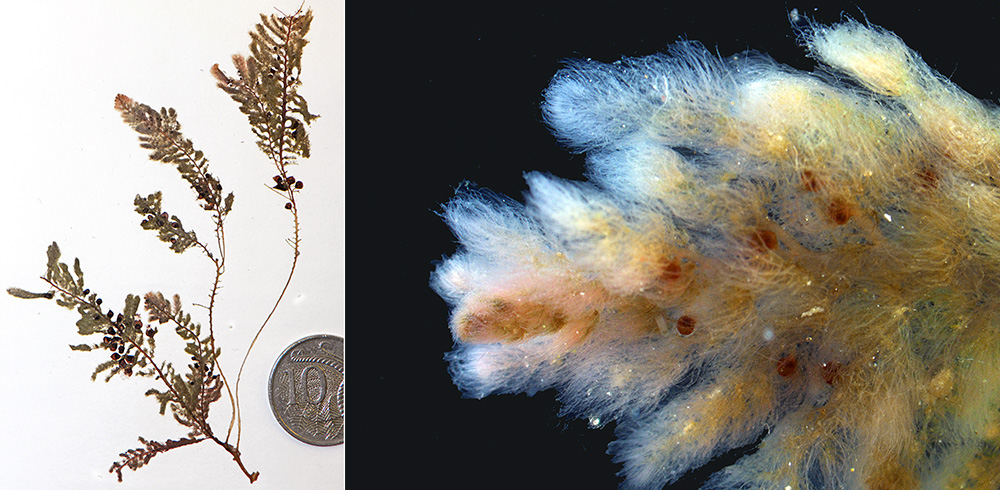
Whole plant (left) of Heterosiphonia muelleri and magnified detail (right) of the fluffy appearance. Photo: Bob Baldock.

One such case came from 5 m deep at Cable Hut Bay, near Cape Spencer, southern Yorke Peninsula, collected by James Brook. The alga was dotted with products of sexual reproduction (cystocarps) looking like the fruits of terrestrial plants.

The alga was Heterosiphonia muelleri (Sonder) De Toni in the Dasyaceae, a family named from “dasya” (Greek) meaning “shaggy”, an appropriate description looking in detail at the fluffy branches of this species (see also the Algae Revealed key to common red algae of South Australia, part V, 2.3mb PDF).
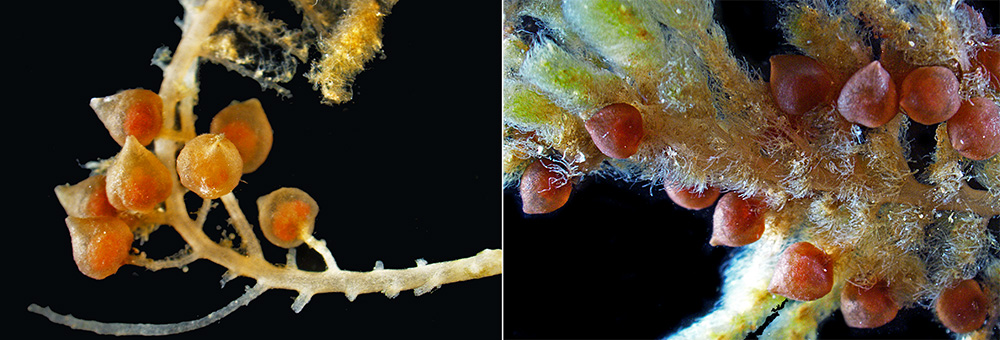
Two magnifications of cystocarps, one on a denuded part of the plant, the other with cystocarps nestled amongst threads. Photo: Bob Baldock.

More remarkable than the mass of thin threads covering the plant were the bright orange to red-brown cystocarps. These were stalked, semi-transparent “flasks”, with elegant conical necks through which the spores (carpospores), clustered within, are released to germinate into the next stage of the algal life cycle, an asexual spore plant. Under the microscope they looked “good enough to eat”, but, unfortunately, would not have proved a sumptuous meal, even though numerous.

With such beautifully reproductive material, identification was practically ensured. A look through the microscope showed ranks of large cell alternating with small ones along main branches, characteristic of the family Dasyaceae.

All that remained was to section and stain blue one of the main branches (axes). A central large cell with a ring of 10 small ones, wrapped (corticated) with even smaller ones was present and clinched the identification.
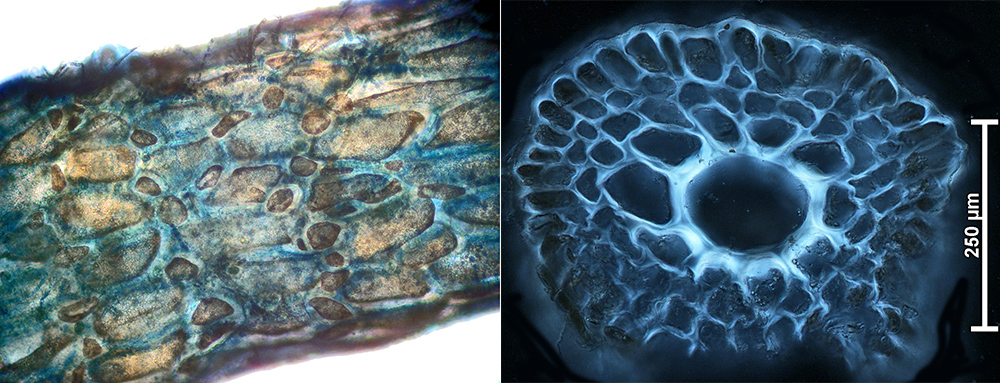
Surface view of a main branch (left) and cross section (right) of the axis of Heterosiphonia muelleri, stained blue and viewed microscopically. Photo: Bob Baldock.

It’s always a pleasure to work with such material, and satisfying when we can be sure of an identification, and I hope this gives you insight into some of the tasks involved in working with algae at the Herbarium.

Contributed by State Herbarium Hon. Associate Bob Baldock.

New journal article & Swainsona Supplement: Nov. 2017

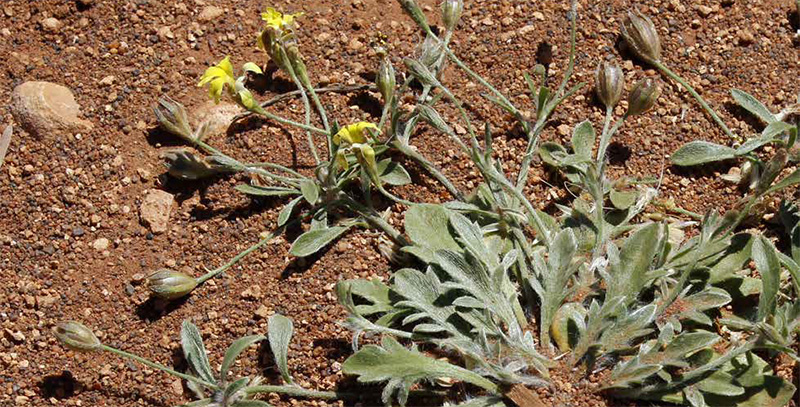
Goodenia asteriscus, flower. Photo: P.J. Lang.

(1) Today, the State Herbarium of South Australia published one paper in the online version of Vol. 31 of Swainsona. The journal was formerly known as the Journal of the Adelaide Botanic Gardens and was renamed this year.

P.J. Lang & R.J.-P. Davies, Goodenia asteriscus (Goodeniaceae), a new arid zone species from northwestern South Australia and eastern Western Australia (1.6mb PDF).

In this article, the authors describe a new species of Goodenia. The plant is a perennial rosette-forming herb, occuring north-western South Australia and eastern W.A. It was first discovered during vegetation surveys in Western Australia in 2011. Later matching specimens were found in the herbarium collections of the State Herbarium of South Australia and the Western Australian Herbarium. A visit to the Anangu Pitjantjatjara Yankunytjatjara Lands in the NW of South Australia enabled Peter Lang to collect new material, including the type specimen.

Goodenia asteriscus, habit. Photo: P.J. Lang.

(2) Furthermore, the Proceedings of next week’s joint meeting of the Australasian Systematic Botany Society (ASBS) and the Society of Australian Systematic Biologists (SASB), including the biennial Invertebrate Biodiversity and Conservation Meeting, were published as Supplement no. 5 of Swainsona (5.1mb PDF). More information on the Conference can be found on its web-site systematics.ourplants.org. More than 140 delegated are expected to attend the 3-day meeting.

To access content of all volumes of Swainsona and the Journal of the Adelaide Botanic Gardens since Vol. 1 (1976), please visit the journal’s web-site at flora.sa.gov.au/swainsona.

Two new native plants in South Australia

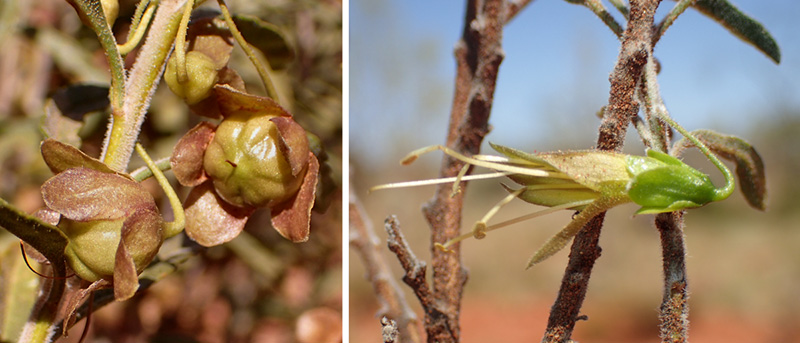
Eremophila undulata: fruit & flower. Photo: P.J.Lang (left) & J.Kellermann (right).

Two new native vascular plant species have just been added to the Census of South Australian Plants, Algae and Fungi. Both are eastern range extensions of species previously considered as endemic to Western Australia.

They were first recorded in the Maralinga Tjarutja Lands in the North-western Region of the State by the South Australian Seed Conservation Centre and are now supported by new occurrences discovered by State Herbarium botanists on the recent BushBlitz Great Victoria Desert Survey in September.

Eremophila undulata: habit & leaf morphology. Photo: P.J.Lang.

Eremophila undulata Chinnock was described by State Herbarium Honorary Associate Bob Chinnock in 1980 (1mb PDF) and the specific epithet refers to its distinctive undulate leaf margins.

Eremophila undulata is related to Eremophila serrulata and has similar golden-green coloured flowers, but it grows in sandy loams on plains rather than the rocky habitats more typical of the latter.

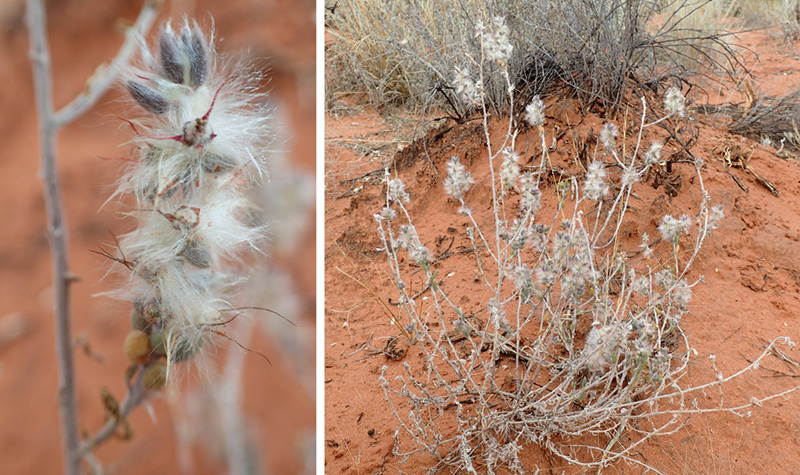
Sclerolaena eurotioides (F.Muell.) A.J.Scott is unusual in having soft filamentous processes in place of the woody spines that are present on most Sclerolaena fruit. It was found during the Bush Blitz survey on the margin of a clay pan to the south of Serpentine Lakes in Mamungari Conservation Park.

Sclerolaena eurotioides: fruit & habit. Photo: J.Kellermann.

Contributed by State Herbarium botanist Peter Lang.

The State Herbarium and weed management in South Australia

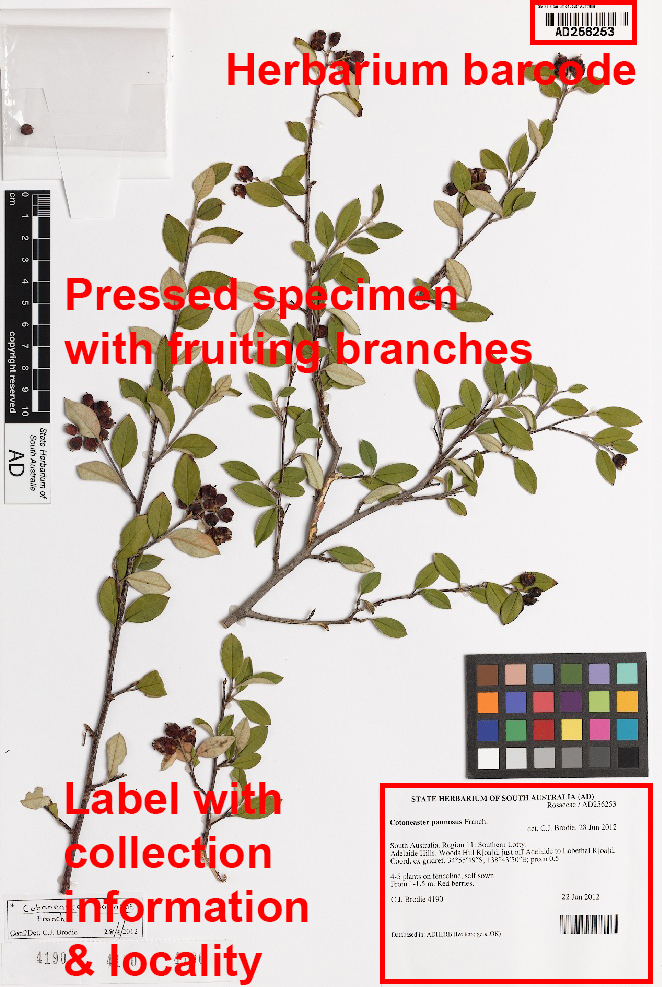
Herbarium specimen of Cotoneaster pannosus, consisting of stems with leaves and fruits, label with collection information, and a barcode that identifies the sheet.

The State Herbarium of South Australia documents and lists all known plant species that grow wild in South Australia. We are able to do this for both introduced and native species, with all observations verified by voucher specimens. These are stored as permanent verifiable records of what species grew where and at which time.

Herbarium specimens have two main components: The actual specimen is normally a pressed and dried plant, or part(s) thereof, that can be used for identification. The second part of the specimen is the data associated with the collection. This includes, but is not limited to, location, frequency, habitat, habit and any other obvious observations. This data are as important as the preserved plant itself. Having one part without the other renders the specimens almost useless.

State Herbarium Weeds Botanist, Chris Brodie is responsible for identifying and cataloguing the wild non-native plants for South Australia. Especially important are any previously unrecorded wild populations of non-native plant species that are new to the State or new to individual regions, especially those in the early stages of establishment that could be the next ”big problem weed species”.

Cardiospermum grandiflorum (Balloon Vine), a species listed as naturalised in 2017. Photo: C.J.Brodie.

Weed species are organisms that adversely impact natural and agricultural environments. Some known problematic weed species in South Australia are:

The Weed Management Society of South Australia (WMSSA) provides a forum to share knowledge, debate issues and generate ideas, drawing on practical weed control experience and the latest research. New members are always welcomed and events are open to all. The Society brings together people actively involved in managing weeds and researchers with interests in protecting our agricultural and natural environments. The main aim of the WMSSA is to minimize the “impacts of weeds in South Australia, on our economy, environment and society”.

At this year’s Annual General Meeting of WMSSA, Chris Brodie was voted in as Secretary of the Society. This is a great opportunity for the Herbarium to involve itself in the wider weeds community in South Australia, and it is with enthusiasm that Chris assumes this role in the Society.

Next year, the WMSSA will be holding its 6th bi-annual conference on 2–3 May 2018 at the Waite Plant Research Centre. Further details can be obtained from the June edition of Weedwise, the Society’s newsletter. All are encouraged to get involved and interested parties should keep their diaries clear for the 6th WMSSA conference in May.

Contributed by State Herbarium Weeds Botanist Chris Brodie.

40 years Mt Lofty Botanic Gardens

On Sunday, 5 Nov. 2017, the Botanic Gardens of South Australia celebrates the 40th anniversary of Mt Lofty Botanic Garden. The birthday party will be held from 10am-3pm. You can enjoy food trucks, live music, nature play activities for the kids, and beer, wine and cider from local Adelaide Hills producers, guided walks and tours, plant sales and more.

Visit the Botanic Gardens web-site for more information.

First envisaged in 1911 by the Director of the Botanic Gardens, Maurice Holtze, as a cool climate arboretum, the first land for a botanic garden in the Adelaide Hills was purchased in 1952 under Noel Lothian. It took many years of planning and planting, until in Nov. 1977 Mt Lofty Botanic Gardens was opened to the public.

Mount Lofty Botanic Garden, Main Lake. Photo: sa-uavs.com.au