Category Archives: News

Happy Taxonomist Appreciation Day!

This day was declared 11 years ago when Californian researcher and Associate Professor in Biology Terry McGlynn decided to boost appreciation of these critical scientists. As the science of organism classification (identifying, naming, describing and ordering), taxonomy underpins all other biological sciences. You need to know what something is in order to study it further: Learn its chemical and physical properties, mimic it for human inventions, or conserve it in the wild. As McGlynn himself said:

Without taxonomists, entire fields wouldn’t exist. We’d be working in darkness.

Whether you realise it or not, you are interested in taxonomy, or at least you use it. When you send your friend a picture of an interesting flower or potential weed you found in your garden, you are seeking to understand taxonomy.

On a grander scale, climate change and the current biodiversity crisis are pressing environmental concerns that cannot be tackled without taxonomy. Experts in some species groups are scarce, and taxonomy itself is a dying art. This is why we say thank you to our taxonomists, and why we encourage people to consider this path for their (and the world’s) future.

Thanks Herbie!

As for the State Herbarium of South Australia in particular: In the year preceding this 2024 Taxonomist Appreciation Day, staff and Honorary research associates published 40 new Australian taxa (species and subspecies) and 3 new combinations (such as the transfer of an existing species to another genus). In addition, botanists from other institutions published 5 new species and 16 new combinations in our journal Swainsona.

Three new species published during the last year: Ptilotus ostentans, Hibbertia fulva and P. durus. Photos: G. Krygsman, K. Brennan & D.J. Duval.

Some of the newly published species are pictures above, they include: Ptilotus ostentans from Western Australia described by Tim Hammer and R.W. Davis; Hibbertia fulva from the Northern Territory published by Tim Hammer; a rare Ptilotus was also published by Terena Lally from the Australian National Herbarium, P. durus, after having been discovered during fieldwork of the South Australian Seed Conservation Centre, several years ago.

On Taxonomist Appreciation Day, we are grateful to all taxonomists who tirelessly describe the world’s biodiversity, but today we would like to highlight the outstanding contributions of long-time researcher, staff member and now Honorary Research Associate Dr Hellmut Toelken, who published a whopping 85% of the herbarium’s 2023-24 taxonomic work.

Two examples of species described by Hellmut can be seen below: Hibbertia prorufa from Sydney (photo: T. Hammer) and H. pustulifolia from the Blue Mountains.
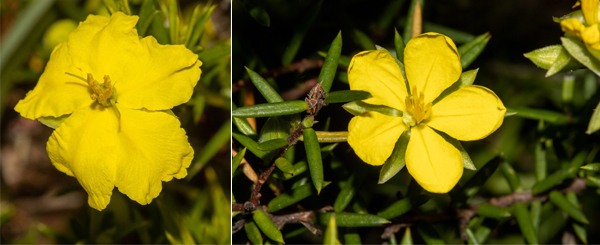
Two species described by H.R. Toelken (from left to right): Hibbertia prorufa and H. pustulifolia. Photos: T.A. Hammer.

So please think of all the toiling taxonomists out there today and pass on your gratitude. Even better, if you are interested in this field, why not pursue taxonomy yourself? With an estimated 75% of Australian biodiversity still to be discovered and described, there’s clearly a pressing need. Maybe we’ll be thanking you and highlighting your contributions in years to come.

Written by State Herbarium staff member Jem Barratt.

New Journal articles: Feb. 2024 (2)

The State Herbarium of South Australia published two further articles in Vol. 38 of its journal Swainsona today, 19 Feb. 2024.

The new species Hibbertia prorufa, near Sydney. Photo: T.A. Hammer.

(1) H.R. Toelken, Notes on Hibbertia subgen. Hemistemma (Dilleniaceae) – 13. The eastern Australian H. acicularis and H. perhamata groups (4.4mb PDF).

Hon. Research Associate Hellmut Toelken continues his revision of Hibbertia in eastern Australia with this contribution on two groups of species allied to the well-known H. acicularisH. exutiacies and H. rufa. In the paper, 36 species are described in detail, of these 28 are new to science. Most species occur in New South Wales and Queensland, a few also in South Australia, Victoria and Tasmania.

(2) D. Nicolle, Transfer of residual species and subspecies from Angophora and Corymbia to Eucalyptus (Myrtaceae) (0.1mb PDF).

In this SHORT COMMUNICATION, Dean Nicolle from the Currency Creek Arboretum publishes several new combinations in the genus Eucalyptus for species that are so far only known as Corymbia or Angophora. This is in order to make the names available to people, who prefer to use a large single genus Eucalyptus, incl. AngophoraCorymbia and the recently published Blackella (Crisp et al. 2024).

To access content of all volumes of Swainsona and the Journal of the Adelaide Botanic Gardens since Vol. 1 (1976), please visit the journal’s web-site at flora.sa.gov.au/swainsona.

Patrick Brownsey (1948–2023) remembered

Pat Brownsey in 2019. Photo: Mike Dickinson, CC-BY-SA (Wikipedia).

World-renowned fern expert Pat Brownsey passed away earlier this month. He was well-known and -liked among his colleagues in New Zealand and Australia. In 2017 he received the Nancy Burbidge Medal, the highest award for botanists in Australasia (issued by the Australasian Systematic Botany Society).

Our colleagues from the Museum of New Zealand Te Papa Tongarewa posted this tribute to his work and his contributions to botany and to the Museum.

A true sea “weed”

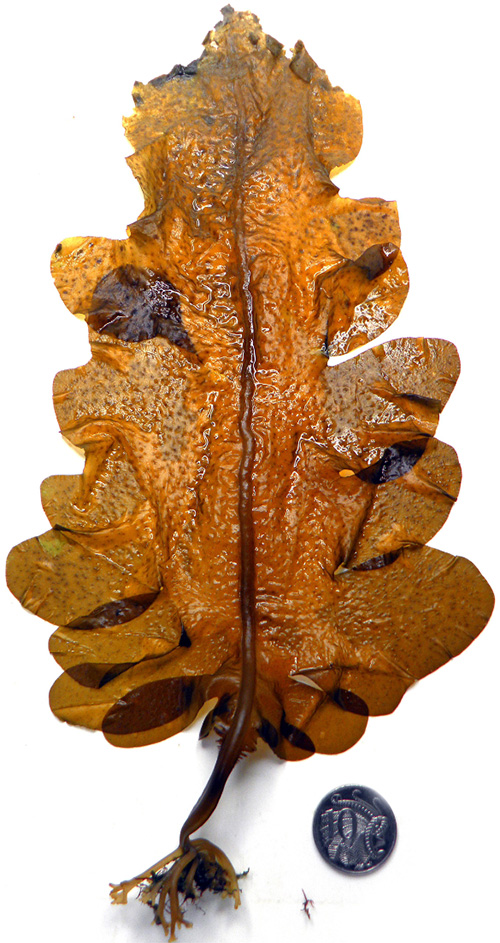
Undaria pinnatifida, fresh specimen before preservation. Photo: R.N. Baldock.

Several weeks ago, Fiona McQueen, one of our volunteers who works in the Phycology Unit of the State Herbarium of South Australia, discovered the invading brown algal species Undaria pinnatifida growing on the pontoon of the marina at Robe in the SE of South Australia.

The species is a declared noxious weed in South Australia and is listed on the national Australian Priority Marine Pest List. The species is one of the world’s 100 most invasive species.

Undaria pinnatifida, also known as Japanese kelp or wakame, is endemic to Japan, where is has been cultivated for centuries as an edible delicacy. It has established in temperate regions throughout the world, including North and South American coasts, and of several European countries. Japanese kelp has also spread across the Pacific, reaching New Zealand and southern Australia, where it has become an opportunistic pest, readily colonising disturbed areas.

For a while, South Australia appears to have avoided the invasion that occurred in Tasmanian and Victorian cold-water coasts; the closest record was from Portland, Vic. From its appearance on Robe’s harbour facility, it is likely that it was transported here on the hulls of boats. The species has a microscopic sexual phase that could easily have been transported that way.

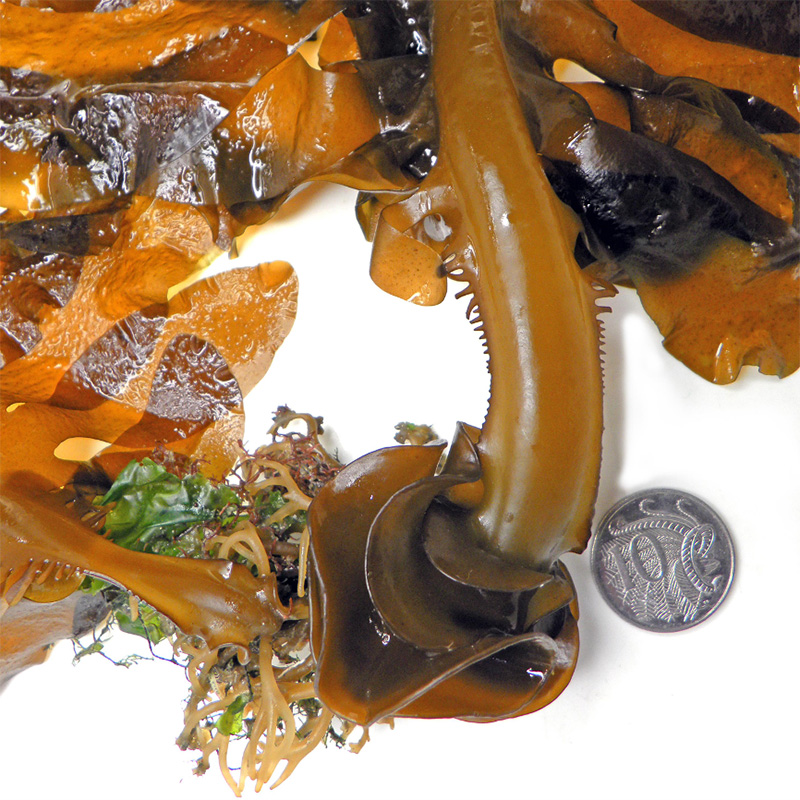
Although Undaria pinnatifida resembles our common kelp, Ecklonia radiata, it can be readily identified when mature because of the spore-bearing frills (sporophylls) wrapped around the base of the stalk.

The species has now been added to the South Australian Census of Plants, Algae & Fungi. The Department of Primary Industries and Regions’ (PIRSA) Biosecurity Division is working on a response to this invasive species. Any detections of Undaria pinnatifida outside of the Robe Marina and Cape Jaffa Anchorage should be reported to FishWatch on 1800 065 522.

Undaria pinnatifida, root-like holdfast showing frilly sporophylls. Photo: R.N. Baldock.

Compiled by Hon. Associate Bob Baldock.

New journal articles: Aug. 2023

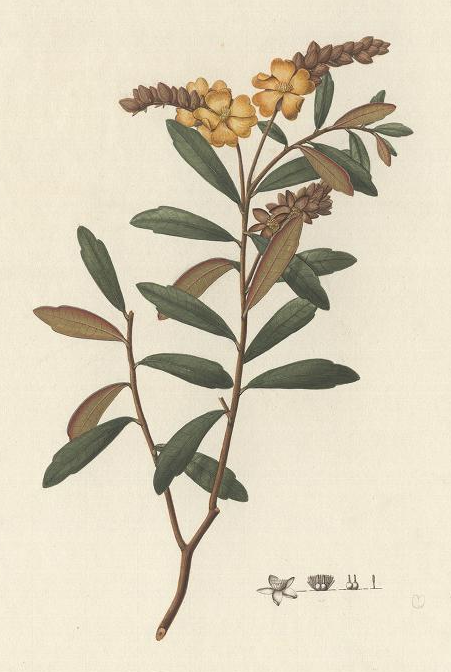
Hibbertia banksii. Watercolour by F.P. Nodder from sketches by Sydney Parkinson, the artist on Cook’s first voyage. Library & Archives, Natural History Museum, London (BM).

The State Herbarium of South Australia published three articles in Vol. 37 of the online version of its journal Swainsona today, 17 Aug. 2023.

(1) H.R. Toelken, Notes on Hibbertia (Dilleniaceae: subgen. Hemistemma) – 12. The northern Australian species of the H. banksii group (3.5mb PDF).

Hon. Research Associate Hellmut Toelken continues his revisions of the species of Hibbertia in Australia with this treatment of Hibbertia banksii and related taxa.

Twelve species and three subspecies are described in detail. Two species and three subspecies are described as new. All these plants occur in tropical Australia, i.e. the northern parts of Western Australia, the Northern Territory and Queensland. Identification keys are provided, as well as a line drawing with all species.

Eucalyptus leucoxylon flower, dissected longitudinally. Scale bar = 5 mm. Photo: J. Salter.

(2) J. Salter, An unusual bud type in eucalypt flower morphology – another character to add to the Eucalyptus (Myrtaceae) suite (11.2mb PDF).

New Zealand botanist Joshua Salter describes a new type of eucalypt bud, particular to Eucalyptus ser. Melliodorae, which includes for example E. leucoxylon (Yellow Gum) and E. melliodora (Yellow Box).

In this bud type, stamens arise from a ‘hinged’ staminophore, infolded on the inner face of the hypanthium, which lifts the stamens up and out at anthesis.

(3) T.A. Hammer, Hibbertia radians (Dilleniaceae), a new combination from South Australia (6.4mb PDF).

Tim Hammer (State Herbarium of South Australia and The University of Adelaide) discusses the subspecies of Hibbertia empetrifolia and describes the subspecies which occurs in South Australia, H. empetrifolia subsp. radians, as a separate taxon, H. radians. It occurs on Kangaroo Island and the Fleurieu Peninsula. Hibbertia empetrifolia is now restricted to southeastern Australia (NSW, Victoria and Tasmania).

Hibbertia radians, growing at Deep Creek National Park. Photo: T.A. Hammer.

To access content of all volumes of Swainsona and the Journal of the Adelaide Botanic Gardens since Vol. 1 (1976), please visit the journal’s web-site at flora.sa.gov.au/swainsona.