Plant of the Month: Mar. 2016

Native ‘Easter lilies’
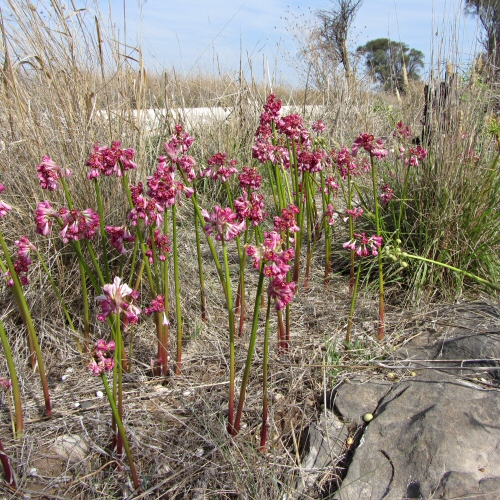
Calostemma purpureum. Photo: L. Jansen

February and March are a tough time for plants; the heat of summer has killed off annual grasses, and few native plants are in flower. It is at this time that, almost miraculously, the flowers of the Calostemma purpureum (garland lily, purple bells) emerge from the hard and parched ground, a cluster of purplish-pink flowers at the end of a fleshy stalk — and not a leaf to be seen.

This species has been chosen as this month’s Plant of the Month: it is a native bulbous herb of grassland and open woodland habitat that features prominently in the current Park of the Month, Shepherds Hill Recreation Park.

When encountered for the first time, Calostemma is often mistakenly thought to be an introduced plant: its robust and succulent appearance simply does not fit the stereotype of a native. In many features it resembles a smaller version of the garden plant belladonna lily (Amaryllis belladonna) and is in fact a member of the same family (Amaryllidaceae). However, Calostemma is uniquely Australian and confined to the eastern part of this continent.
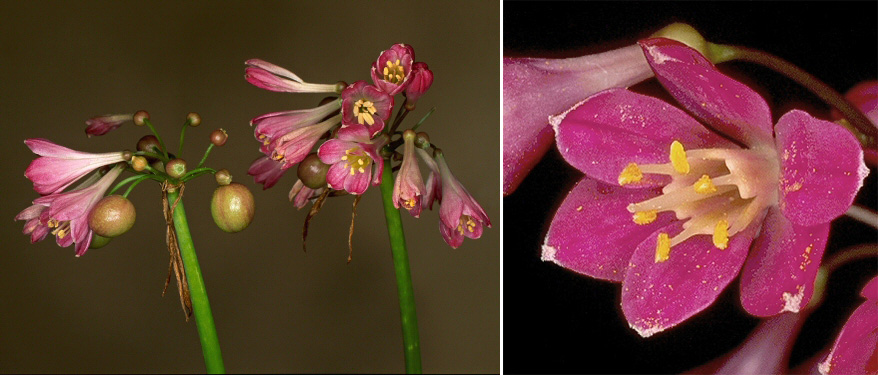
C. purpureum, flowers and close up showing corona. Photo: P.J. Lang

Although their initial appearance is usually triggered by a fall of rain, their flowering and growth is sustained by a bulb about the same size as that of a daffodil. The bulbs are buried deep, as much as 30 cm below the ground, having been pulled down a little further each year by contractile roots. By the end of summer each mature bulb is primed with three almost fully developed flower stalk buds awaiting the signal to expand as soon as some rain arrives.

These plants have reversed the usual cycle of a spring flowering after winter vegetative growth prevalent in Mediterranean climates. Instead, Calostemma behaves like a number of other autumn flowering species where flowers first appear on their own, with the leaves to follow later. Calostemma remains in its vegetative growth phase through winter and spring when conditions are much more favourable, until eventually the fleshy strap like leaves die back again for summer.
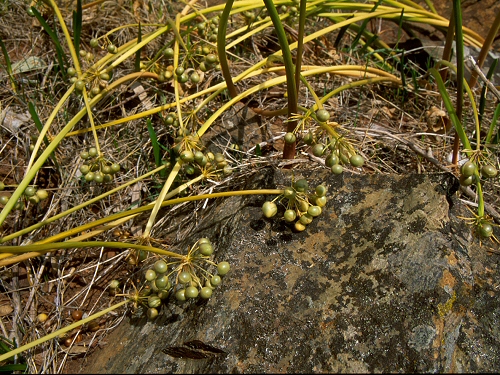
C. purpureum, plants weighed down with fruit. Photo: P.J. Lang

One of the most fascinating aspects of the garland lily’s ecology concerns its seeds, strictly ‘pseudoseeds’, which behave as bulbils. These are green, water-rich, fleshy but firm and similar in appearance to a large pea. The fruit itself is reduced to a mere papery shell surrounding the seed. The flowering stems dehydrate as the fruits swell, leaning over under their growing load. Soon the stems become prostrate and release the fruits, so dispersing them by a radius equivalent to their height. This limited reach is enhanced by the ability of the seeds to roll down-slope, to float in water, and perhaps sometimes to be carried and dropped by birds.

Perhaps the most remarkable feature of these propagules is their lack of dormancy. They start to ‘germinate’ as soon as they are mature and do so without water, drawing on the moisture contained within them. The cotyledon with root and shoot sometimes even emerge while it is still attached to the plant.

Calostemma was first described by Robert Brown in 1810. The name is derived from the Greek καλός [calos], beautiful, and στέμμα [stemma], garland or crown, which refers to the conspicuous golden corona in the centre of the flower formed by the fusion of the six stamens.

Calostemma purpureum often grows in dense colonies, and can create a mass of pink when in full flower. Flower colour on individual plants varies from a purplish maroon to pale pink and occasionally white.
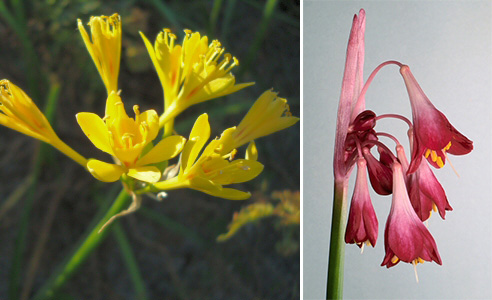
C. luteum (right, photo: SA Seed Conservation Centre) and C. abdicatum (left, photo: P.J. Lang)

The genus has two other species, both found in South Australia. The slightly larger yellow-flowered Calostemma luteum (yellow garland-lilly) occurs in the Riverland and Lake Eyre drainage systems. The aptly named Calostemma abdicatum (the epithet is from the Latin abdico to disown, renounce or resign) is remarkable in lacking the definitive corona, from which the genus takes its name. It is endemic to the Everard Ranges in the Anangu Pitjantjatjara Yankunytjatjara Lands in the north-western region of the State, and was described as a new species by State Herbarium Botanist Peter Lang in 2008.
Adelaide Fungal Study Group

Adelaide Fungal Study Group logoThe Adelaide Fungal Study Group (AFSG) is convened by State Herbarium Hon. Associate Pam Catcheside. The group is open to anyone interested in the scientific study of fungi. It is a Club of the Field Naturalists Society of South Australia. Members of AFSG must also be members of the Field Naturalists Society of S.A. (membership $35.00 p.a., concession $25.00 p.a.). Additional membership fee for the Group is $5 p.a.

Meetings of the Adelaide Fungal Study Group take place on varying Tuesdays of the month in the State Herbarium of South Australia, Hackney Road, Adelaide, 7.30pm.

Extra meetings & forays (collecting trips) may be arranged, and changes will be made, to take advantage of fungal fruiting times and good fungal sites. There will be no excursions from November to March inclusive. At meetings held during the fungal season, collections made during the previous weekend’s foray will be examined, described and identifications made.

3 fungi image

The first meeting for this year is scheduled for Tue., 8 Mar. 2016, 7:30-9:00pm.

Agenda

  • 7:30-8:00 Ratification of programme for 2016.
  • 8:00-8:10 Thelma Bridle. Orchid mycorrhizas.
  • 8:10-8:20  Samra Qaraghuli. Screening macrofungi for inhibitors of biofilm formation by Staphylococcus aureus.
  • 8:20-8:30 Tara Garrard. Nematophagous fungi.
  • 8:30-8:40  Rose Dow. Fungi in soils; ‘Nature’s Recyclers’. A poster for Arbury Park Outdoor School.
  • 8:40-8:50  Sarah Harvey. Summer projects at the State Herbarium of SA.
  • 8:50-9:00 Pam Catcheside. Rare and under-collected small, black discomycetes.

New members interested in the group’s activities should contact Pam Catcheside (pam.catcheside@sa.gov.au) for more information.

Summer scholarships

Summer scholarship students Sarah Harvey & Jessica Burdon

Aside from managing a collection of over one million specimens and providing botanical expertise, the State Herbarium of South Australia seeks to inspire new generations of botanists to pursue a career in that field. For a select number of university undergraduates, the Herbarium provides opportunities to gain first-hand experience in the Herbarium’s work, whether it be in specimen curation or taxonomic research. The Herbarium has been doing this through a program of summer scholarships where some of the most promising students are offered the opportunity to enhance their skills and knowledge and gain first-hand career experience. Two students, Jessica Burdon and Sarah Harvey from the University of Adelaide School of Biological Sciences, were offered this opportunity over the summer break.

Jessica had already commenced volunteering with the Herbarium to assist with a project to photograph exemplar specimens of the South Australian vascular flora. These high resolution images will support electronic flora descriptions and other applications enhancing the availability of knowledge of the State’s flora.

Fresh Carpobrotus specimen photographed before drying

During her internship, she has also been involved with the Carpobrotus project currently being run by Herbarium staff. This project, being carried out in collaboration with the Adelaide and Mt Lofty Ranges Natural Resource Management Region and Birdlife Australia is conducting surveys and research into the level of invasion of a weedy hybrid of the coastal succulent plant pigface. Her work has included supporting the curation of incoming specimens and extraction of seeds for investigation and cultivation. Jessica will also learn techniques for seed photography, microscopy and data capture associated with the use of taxonomic information, and how to apply all this knowledge to on the ground decision making and management.

Sarah has been involved with the Adelaide Fungal Studies Group, organised by Honorary Research Associate Pam Catcheside. Her internship roles have included two main projects. The first is assisting Technical Officer Carolyn Ricci with a problem involving the group of red algae that contain carageenans, compounds highly valued, for example, for use as thickening agents in ice-creams. The dried specimens of this group gradually break down owing to specific chemical processes which occur after preservation. As a result the specimen sheets have been discovered to degrade in such a way that they ‘melt’ forming an unstable mess and emitting a sulphurous compound that degrades the plant and paper and most things in contact with it. The work in handling these specimens involves initially making high quality photographs of the specimens and then beginning some curatorial ‘rescue’ activities. The images of what remains of the current specimens will act as a record of the specimen before they completely self-destruct. These images will able to be incorporated into the specimen record in the new Herbarium data system, which is currently being developed.

Two specimens of ‘melting algae’. The left specimen is deteriorated black on both ends, with a red intact section between. The right specimen is badly damaged, even though it was collected relatively recently, in 1971.

SEM image of pollen of Sphaerocarpos

Sarah’s second project has been to assist Senior Botanist Graham Bell with a small project documenting the occurrence and taxonomy of an introduced liverwort, Sphaerocarpos, in South Australia. Whilst the presence of this liverwort in Australia was officially published in 1980, little work on its distribution has been undertaken and very few specimens are held in Australian herbaria. Graham first found the species in the State in 1989 and has since collected a number of specimens, amongst which he has identified a second species, not yet recorded for Australia. As the species can only be separated accurately by examination of the spores, slides of spores have been prepared from all specimens and these have are being examined by light microscopy and scanning electron microscopy (SEM) to verify surface features.

Both students have been working with a high degree of professionalism and skill and have been a welcome addition to the summer work of the Herbarium.

Field to database—documenting the flora of Melanesian Islands

It’s All About the Plants
Tuesday, 8 March 2016, 10:30–12:00
Goodman Building Lecture Theatre,
adjacent to the State Herbarium of South Australia
Adelaide Botanic Garden, Hackney Road

by Shelley A James
iDigBio, Florida Museum of Natural History, USA

ShelleyJ_pressingDr James’ research interests focus on the diversity and biogeography of the flora of the Pacific region. For more than six years, she has been undertaking field work in Papua New Guinea and, recently, the Solomon Islands, collecting new botanical specimens in remote locations, and digitising herbarium collections from the Pacific. Now working for iDigBio (Integrated Digitized Biocollections), the US initiative mobilising biological specimen data, she liaises between museum collections staff, researchers, educators and cyberinfrastructure to promote the use of natural history collections and the data they contain in answering big science questions.

Previously, Shelley was a botanist in the Herbarium Pacificum and manager of the Pacific Center of Molecular Biodiversity at the Bishop Museum in Honolulu, Hawai’i.

ShelleyJ

Dr Shelley James (iDigBio Data Management Coordinator)


All Herbarium staff, honoraries, volunteers, students and guests welcome. Morning tea provided.

State Herbarium open days 2016

History festival bannerAs in previous years, the State Herbarium of South Australia will be open to the public on the weekend of 7 & 8 May 2016 as part of the South Australia’s History Festival.

The heritage-listed 1909 Tram Barn A was once part of a complex housing the Adelaide tram fleet.  Now the State Herbarium, it houses over one million plant specimens instead. See some of the first plants collected in the state on Matthew Flinders’ voyage and learn how all these dried specimens are critical to the effective preservation of living plants.

Read more about Tram Barn A (1.15mb pdf), the State Herbarium (733kb pdf) and the over one million plant specimens (561kb pdf) in booklets published by the institution.

Guided walking tours will be available on both 7 & 8 May at 11am & 1pm (duration 45-60 min, max. 15 persons per tour).

Bookings are essential.

Please subscribe to the State Herbarium’s blog to find out more about its activites, events and publications.