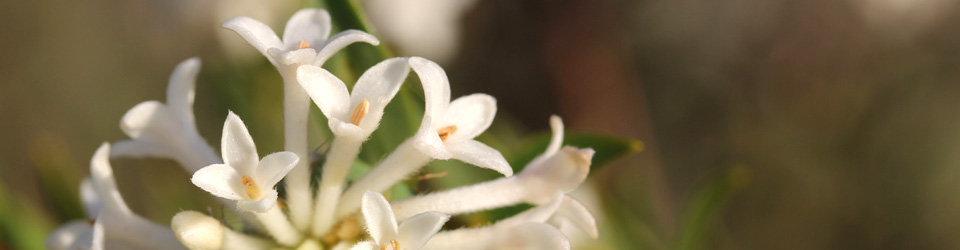
The State Herbarium has chosen Eucalyptus camaldulensis Dehnh. (river red gum), as Plant of the Month for February 2016. It is an iconic tree across South Australia and in the Murray River National Park, this month’s Park of the Month.
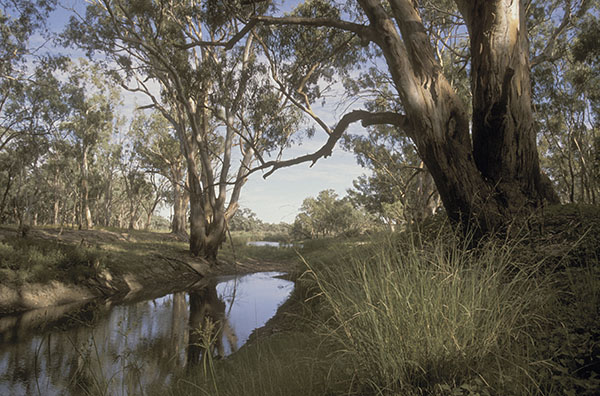
River red gums at Katarapko Island, Murray River National Park. Photo: Peter Canty.
Eucalyptus camaldulensis has one of the widest natural distributions for an Australian tree, and is one of the most commonly cultivated eucalypts around the world. Accordingly this wide distribution has produced much variation, and seven subspecies are now recognised, E. camaldulensis subsp. camaldulensis occurs along the Murray River.
The habitat of E. camaldulensis is typically along watercourses and floodplains, however the species also occurs on hills in the Mt Lofty Ranges. Its tolerance to flooding is in part due to its massive size and its ability to grow roots quickly and produce adventitious roots on submerged stems. One study has shown that 9 month old cloned plantlets could produce more than 8 km of roots. Its seed floats for some time and is released predominantly during flooding months.

“Spirit of endurance”, Harold Cazneaux well-known photograph of a river red gum near Wilpena Pound, Flinders Ranges. Art Gallery of NSW.
The trees ability to attain massive sizes with hollows makes it an important habitat for many animals (regent parrots, bats, possums, goannas) and insects (49 species have been recorded from a E. camaldulensis forest canopy on the river). Submerged roots and branches are important to many fish like the murray cod. Many intimate fungal associations also exist, one example being the basidiomycetous yeast Cryptococcus gattii. This is released from the tree during flowering and has resulted in the deaths of immune suppressed people (pdf) in Australia and around the world where E. camaldulensis grows, the spores being transported to other countries with the seed.
The age of large trees is difficult to ascertain in part due to the natural hollow formation, some authors indicate ages from 500 to 1000 years. The long history of human use of the tree is still very evident from all the Aboriginal Nations along the river, with many canoe and shield trees found on living and dead trees of considerable age. More recent use has seen the wood used for heavy construction, railway sleepers, furniture and firewood. Honey and a good source of pollen for bees is also significant.
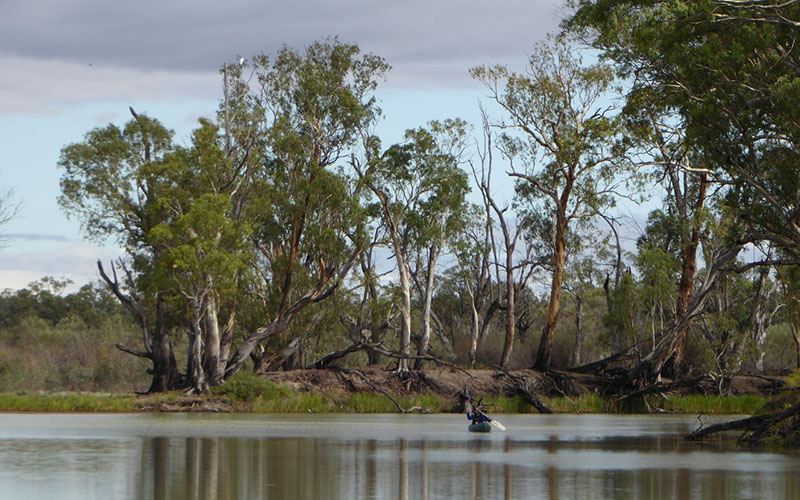
Canoeing under river red gums along Katarapko Creek, Murray River National Park. Photo: Juergen Kellermann.
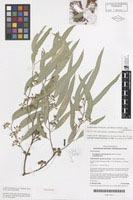 The name relates to the cultivation of the type specimen at Camaldoli near Naples in Italy in 1832. However study of the type indicated that it was another eucalypt, possibly quite unrelated. An earlier used name, E. rostrata Schltdl., was invalid, while a name given by Mueller, E. longirostris F.Muell. ex Miq., was valid. Because the name E. camaldulensis is so widely used around the world, Brooker & Orchard (2008) applied to conserve the name and select a new holotype. This was successful and a Dean Nicolle collection from Currency Creek was selected. The full discussion of this fascinating typification can be found in a paper by McDonald et al. (2009).
Feel free to contact the State Herbarium’s expert on the eucalypt family Myrtaceae, Martin O’Leary (martin.oleary@sa.gov.au), for specific references or more information.
Further reading can be found at:
- J.Williams & J.Woinarski. (eds). Eucalypt ecology: individuals to ecosystems. Cambridge University Press. 1997.
- http://www.anbg.gov.au/cpbr/WfHC/Eucalyptus-camaldulensis/
- Nicolle, D. (2014). Myrtaceae (partly) (version 1) [10MB PDF]. In: Kellermann, J. (ed.), Flora of South Australia (ed. 5). 102 pp. (State Herbarium of South Australia: Adelaide). flora.sa.gov.au/ed5
- Anon. (2010). River red gum woodlands of watercourses and floodplains. (SA Arid Lands NRM Board: Port Augusta). [560KB pdf factsheet]
 instrumental in improving the condition of, and knowledge about the Island’s native vegetation for over 35 years
 The State Herbarium of South Australia wishes all its friends, volunteers, Hon. Associates and Affiliates a happy Christmas break and all the best for the New Year.


You must be logged in to post a comment.