South Australia’s 5000th plant

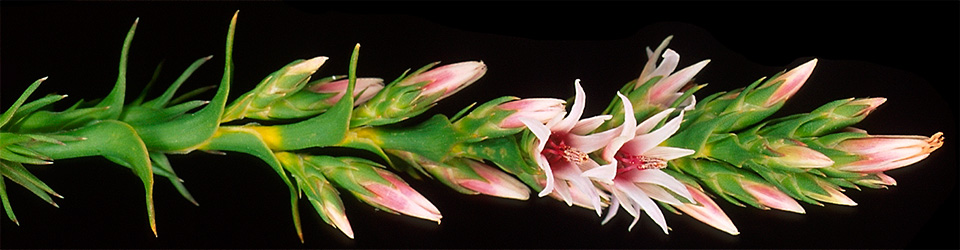
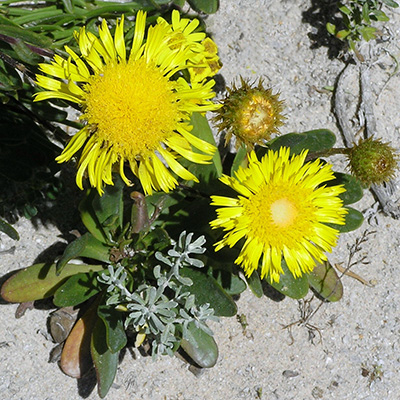
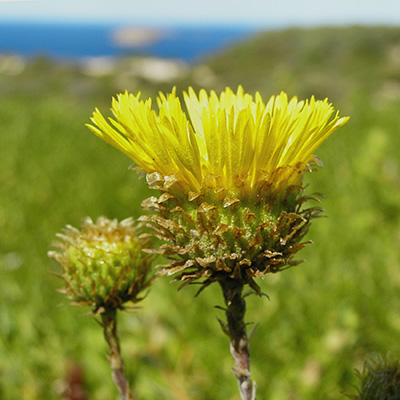
    Podolepis rugata ssp. trullata, INP 0296, near Cape Spencer, YP by T.M.Jaques, flower & bud lateral, edit crop sq

The State Herbarium of South Australia has added the 5000th vascular plant to the Census of South Australian Plants, Algae & Fungi. Podolepis rugata subsp. trullata (“pleated daisy”) is a rare native daisy with striking yellow flowers. The subspecies was named this year in an article in the taxonomic journal Muelleria (1mb PDF) by Jeff Jeanes from the National Herbarium of Victoria, who is an expert in this group of plants.

“trullate” involucral bracts

The new daisy has a limited range, and occurs only in Innes National Park, Althorpe Islands Conservation Park and Busby Islet, off the northern shore of Kangaroo Island. The scientific epithet “trullata“, is derived from Latin and means “trowel shaped” and describes the shape of the small leafy bracts around the flower-head.

In a press-release, Chief Botanist Prof. Michelle Waycott said that the discovery is particularly special as 2015 marks the 60 year anniversary of the State Herbarium of South Australia.

“The pleated daisy was found in Innes National Park by amateur naturalists Trudie Jaques and Tony Lewis, who recognised its unique appearance. Thanks to photos and specimens they collected under a scientific permit we were able to formally identify the plant.”

Founded in late 1954 the State Herbarium provides foundational knowledge about what plant species occur in the wild in South Australia, including both weeds and natives.

“Every year around 50 new records are added to the State’s list of species. This is one of the primary roles of the Herbarium, to discover, study, describe and identify plant species so they can be formally recognised and consistently identified. The Herbarium is also responsible for maintaining the collection of all of South Australia’s known species of plants, fungi, mosses, lichens, algae and seaweeds.”

The State Herbarium of South Australia’s collection includes more than one million specimens valued at more than $71 million. Many of these specimens are priceless as their plant species and communities no longer exist.

“The history of the collection is a very important scientific tool, providing snapshots of plants and their locations throughout European settlement. It shows us where and how plant communities have changed over time, including species that are now extinct in the wild. It’s through the recognition of each unique species that we can understand and manage them appropriately, whether it be a rare pleated daisy or an aggressive weedy dandelion.”
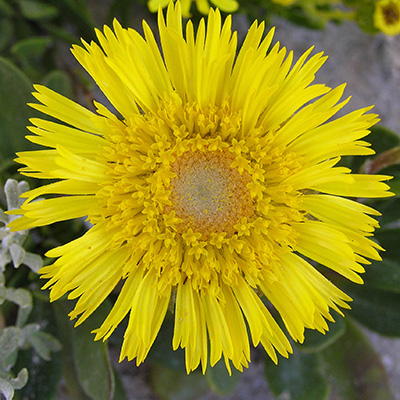
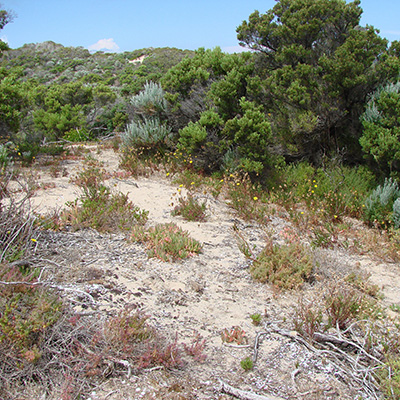
Podolepis rugata ssp. trullata, INP 0296, near Cape Spencer, YP by T.M.Jaques, flower edit crop sq    Podolepis rugata ssp. trullata, INP 0895, near Pondalowie, YP by T.M.Jaques, habitat crop sq

New journal articles: Nov. 2015

Hibbertia spanantha Toelken & A.F.Rob.

Today, the Journal of the Adelaide Botanic Gardens released three articles online:

To access content of all volumes of the Journal of the Adelaide Botanic Gardens since Vol. 1 (1976), please visit the journal’s web-site at flora.sa.gov.au/jabg (the Journal is also available through JSTOR).

Salt marsh restoration on Torrens Island

It’s All About the Plants
Tuesday, 3 November 2015, 10:00–12:00
Ground Floor Meeting Room
State Herbarium of South Australia
Old Tram Barn Building, Hackney Road

by Doug Fotheringham
State Herbarium of South Australia

Turning sand dunes into salt marshes on Torrens Island. What happened then and how does it look 25 years later.

Doug is the newly appointed Hon. Research Associate of the State Herbarium of South Australia and will speak about his involvement with the restoration of the vegetation of the island and his recent visit in Aug. 2015.

The same site on Torrens Island in 1988 (left) and 2015 (right). (Photos D. Fotheringham)

All Herbarium staff, honoraries, volunteers, students and guests welcome. Morning tea provided.

Seminar postponement

Please note that the next It’s All About The Plants seminar has been postponed until next month. On Tuesday, 3 November Doug Fotheringham (our newest State Herbarium Honorary Research Associate) will give a presentation.

Life in the sea: A mini-mesh plant

State Herbarium Hon. Associate Bob Baldock from our Phycology Unit provided these photographs of Thuretia australasica.

This small, red alga was found attached to the stems of a seagrass collected at the Head of the Great Australian Bight in 2010. At first glance the plant appears mundane, even uninteresting.

But, under the microscope, a delicate mesh of microscopic threads forming the small, hollow, cylindrical plant body is revealed, another example of the surprises awaiting us in the microscopic world. (Note that the white, glassy particles are sand grains trapped in the mesh and not part of the alga.)

Thuretia 3Click here for a detailed description of the species from the online version of Prof. H.B.S. Womersley‘s Marine benthic flora of southern Australia.  More images can be found in Bob Baldock’s Algae revealed fact-sheet “Pictured key to some common re-mesh algae of southern Australia” (1.3MB PDF).  A detailed colour plate from W.H. Harvey‘s Phycologia australasica is available from the Internet Archive (under the name Thuretia teres).