Category Archives: News

Jessie Hussey inspires school teachers

State Herbarium of South Australia, specimen AD 96920168

Pimelea husseyana was named after Jessie Hussey by Ferdinand von Mueller in 1894; it is now called Pimelea phylicoides. This specimen collected in 1897.

This week, Lisa Waters from the State Herbarium gave a presentation to a group of 50 primary school teachers about her research on the 19th century plant collector and amateur botanist Jessie Hussey. She was invited by Prof. Martin Westwell (Flinder Centre for Science Education in the 21st Century, Flinders University), who is currently Scientist in Residence at the Department for Education and Child Development (DECD), working with teachers on the science curriculum, with particular emphasis on the Science as a human endeavour strand.

Jessie Hussey lived from 1862–1899 in Port Elliot. Her passion for botany helped her to make a significant and pioneering contribution to the knowledge of South Australia’s terrestrial and marine flora during the 1890s. She became a respected collaborator of many leading national and international botanists and phycologists.

Lisa is researching the life and work of Jessie Hussey for over 5 years. In 2012 she travelled to Europe on a Churchill Fellowship, to visit herbaria in Sweden, Germany, Great Britain and Ireland, where specimens collected by Jessie Hussey are held, as well as many of the letters she wrote to overseas scientists.

“Jessie’s story, and Lisa’s own story of investigating Jessie’s life and work, provided us with inspiring examples of how science can really come alive and be much more meaningful when we hear the personal stories involved.“ — Prof. Martin Westwell


Seagrass book published

State Herbarium of South Australia’s Chief Botanist Michelle Waycott and her co-authors Kathryn McMahon & Paul Lavery (Edith Cowan University) published their new handbook to southern temperate seagrasses last month.

A guide to southern temperate seagrasses
M. Waycott, K. McMahon & P. Lavery
CSIRO Publishing, $29.95

Title pageThe book describes the exceptionally diverse seagrasses in the temperate parts of the southern hemisphere, i.e. off the coasts of southern Australia, New Zealand, southern South America and southern Africa. It introduces readers to the evolution, biology and ecology of these plants and presents detailed information on each species, with many photographs and drawings.

This is the second book in a series of guidebooks on the seagrasses of the world. The first volume was entitled A guide to tropical seagrasses of the Indo-West Pacific, published in 2004 by James Cook University.

The current volume can be purchased via the CSIRO web-site or in well-stocked bookshops. A limited preview of several pages is also available on the web-site.

How many plants are unique to South Australia?

Endemics in SA (Feb. 2014)The answer is 418 … at present. A recent review by State Herbarium botanist Peter Lang reveals that South Australia currently has 418 endemic vascular plant taxa (species, subspecies & varieties): these are native plants that occur naturally nowhere else. Some have a relatively wide distribution that happens to be contained within the State borders, but most are restricted to smaller areas. The number of such endemic taxa changes as new species are described and our knowledge of plant distributions improves.

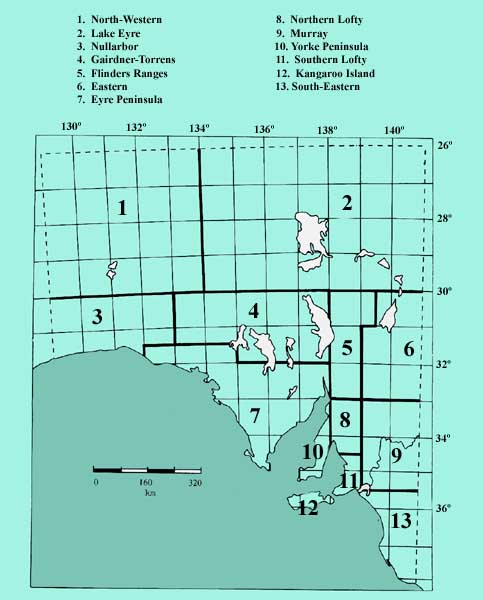
A similar question may be posed for each of the 13 botanical regions (as used by the State Herbarium of South Australia). The chart shows the percentage for taxa that are confined to a single botanical region only. Two regions, Kangaroo Island (KI) and Eyre Peninsula (EP), stand out as having the highest percentage of regionally endemic plants. The presence of mountain ranges and restricted habitats, as well as isolation by sea levels both past and present, appear to promote the development of locally endemic flora.

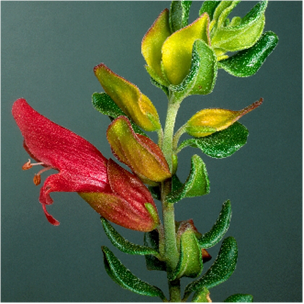
Pictured are examples of two South Australian endemic plants: Anthocercis angustifolia, endemic to the Mt Lofty and Flinders Ranges, and Prostanthera calycina (West Coast Mintbush), endemic to western Eyre Peninsula.

Picture by P.J. Lang

Prostanthera calycina

Photo by P.J. Lang

Anthoceris angustifolia

The invading flora: a regional account of the assault

Recently, State Herbarium botanist Peter Lang has compiled the numbers of vascular plants occurring in the wild in South Australia for 2013.  There are 4,940 taxa (= species, subspecies & varieties) in the state, of which 1,267 taxa (25.6%) are naturalised alien plants (weeds). A further 232 taxa (4.7%) are questionably naturalised: these are, for example, plants that are found in cultivation and have escaped, but it is not proven whether they will maintain their wild populations. Including these the total for alien taxa is 1,499 (30.3%), or almost one third of plants found in the State.

The graph below depicts the numbers of plants for each of the 13 botanical regions (as used by the State Herbarium). The lowest number of introduced taxa is found in the NW (North Western) region of the State, with only 5.9% of naturalised and questionably naturalised plants. The SL (Southern Lofty) region, which includes Adelaide, the Adelaide Hills and Fleurieu Peninsula, has the highest number of alien plants, 46.4%. As expected, more remote regions, away from large settlements, have fewer naturalised and questionably naturalised taxa.

Weeds are not only introduced through agricultural practices, but also escape from gardens. Plants listed as questionably established highlight potential weeds of the future and warrant monitoring or control, to prevent them becoming established.

Click here to see the original data.

Numbers of native (incl. questionably native), naturalised and questionably naturalised plants in South Australia (as of 11 Dec. 2013)


Christmas greetings

Spitzingsee in the Bavarian Alps, Germany

The State Herbarium of South Australia wishes all its friends, volunteers and Hon. Associates a happy Christmas break and all the best for the New Year.  We hope to see you all again in 2014.