Today, 18 Nov. 2026, the State Herbarium of South Australia published two new articles in Vol. 29 of the journal Swainsona. These two papers conclude this volume of the journal…
J.L. Dowe, Botanical plates and figures in publications by Ferdinand von Mueller: A summary and checklist (34.8mb PDF), 82 pp.
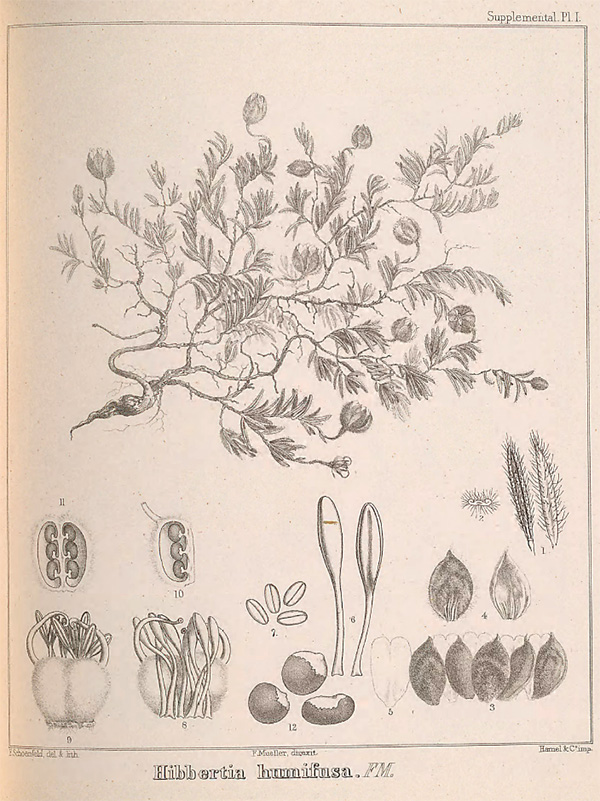
Lithograph of Hibbertia humifusa published in “Plants indigenous to the colony of Victoria” (1860-62).
The author of this monograph reports on the illustrations that were produced for the publications of Ferdinand von Mueller, Australia’s pre-eminent botanist of the 19th century. Many of Mueller’s numerous articles, scientific papers and books were illustrated with lithographs, wood cuts, metal engravings and nature prints.
Short biographies are presented of the 36 illustrators, lithographers and engravers that worked with Mueller, as well as their contributions to his botanical works. A 27-page Appendix lists every illustration with their publication details. About 810 currently recognised taxa were illustrated, predominantly plants, but also bryophytes and fossils.
This paper adds to the growing scholarship on Ferdinand von Mueller and his contribution to Australian science.
P.S. Catcheside, D.E.A.Catcheside & S. Correll, A tiny eyelash disc fungus found on cat faeces is the first collection of Rhizoblepharia jugispora since 1964 (1.2mb PDF), 3 pp.
The fungal species Rhizoblepharia jugispora was described in 1968 from a specimen collected at the Glenelg River in Victoria. Until now, it was only known from the type collection, preserved in three herbaria: the Kew Herbarium (K), the University of Melbourne Herbarium (MELU) and the Cornell Plant Pathology Herbarium (CUP).
Earlier this year, the authors of this paper found a new record of this species on Kangaroo Island. The disc fungus is 1-3 mm in diameter and up to 1 mm high, plane to shallowly concave with a slightly raised margin surrounded by long dark brown “eyelashes”. Several discs were found growing in a heathland on cat faeces. Microscopic characters also confirmed the identity of the species.
Pam and David Catcheside have surveyed fungi on Kangaroo Island for over 25 years. They published many of their findings in reports, scientific papers and in the book The fungi of Kangaroo Island – and beyond (2024). This Short Communication shows that even after documenting the diversity of fungi for such a long time, it is possible to find new records. There are now well over 750 fungi known from the island.
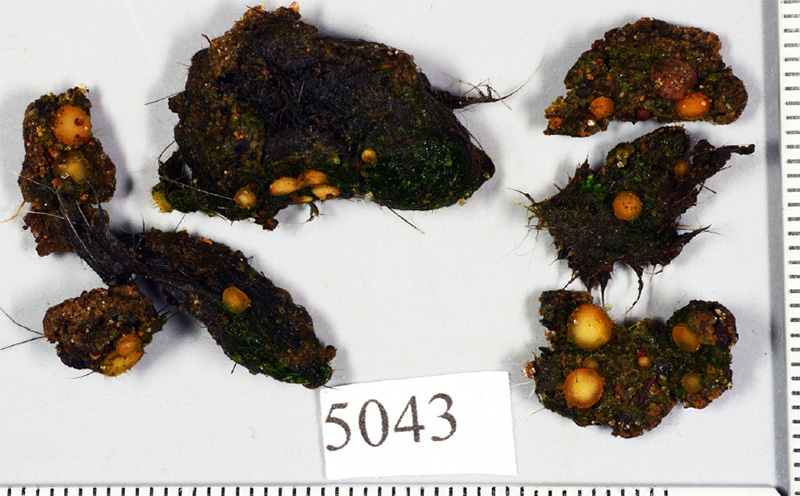
Rhizoblepharia jugispora. Several disc fungi growing on cat faeces, collected on Kangaroo Island. Photo: D.E.A. Catcheside.
To access content of all volumes of Swainsona and the Journal of the Adelaide Botanic Gardens since Vol. 1 (1976), please visit the journal’s web-site at: https://data.environment.sa.gov.au/Plants-and-Animals/Herbarium-Journals/