Category Archives: News

Happy National Eucalypt Day 2020!

Eucalyptus pimpiniana​, growing in front of the State Herbarium. Photo: A. Thornhill.

March the 23rd marks National Eucalypt Day (see fact sheet from 2018, 360kb  PDF) in Australia. Prior to COVID-19 the Botanic Gardens and State Herbarium had been preparing for two different eucalypt themed tours at Adelaide Botanic Gardens with State Herbarium and Botanic Gardens staff on the 22 and 23 March 2020. Unfortunately we have been forced to cancel them.

We will reschedule these tours sometime in the future but until then we will share some thoughts about this interesting group of plants that marks the occasion.

The eucalypts are actually three genera of predominantly Australian plants: Angophora, Corymbia and Eucalyptus (see also Australian Plants Society fact sheet, 4.5mb PDF). There are over 800 named species of eucalypts. While the majority of eucalypts are purely native to Australia there are a handful of species that have escaped the continent to the north and are native to Timor, New Guinea, Indonesia and the Philippines. The revised Flora of South Australia treatment for eucalypts was published in 2014 (33.8mb PDF).

May Gibbs Stamp, 2016

The living species that occur outside of Australia have fossil ancestors. In fact, the oldest known eucalypt fossil comes from Patagonia and is 52 million years old. Eucalypt fossil leaves have also been found in New Zealand, estimated to be about 20 million years old. We know though that eucalypts are not now native to either South America or New Zealand so at some point they became extinct in those countries and left Australia with an iconic plant group. An article on The Conversation last year discussed how the eucalypts came to dominate Australia.

The eucalypts gained great popularity through the creative works of May Gibbs in 1920s. These artworks have also been celebrated in Australian Stamps.

May Gibbs Stamp, 1985

It is poorly known that when May Gibbs first came to Australia as a child she first lived in South Australia, including in Norwood for a short time. Her family then moved to Western Australia where she spent most of her formative years. May Gibbs’ most famous characters, the gumnut babies Snugglepot and Cuddlepie, use various parts of eucalypts for their clothes. The most well-known pictures of the gumnut babies sees them sitting in big gumnuts which in fact are Corymbia fruit and not of Eucalyptus, most likely Corymbia ficifolia a native tree of Western Australia, and also a common street tree all around Australia. The hats that the gumnut babies wear are the calyptra (cap) of a eucalypt — petals that have evolved to form a protective bud cap. When a eucalypt flower opens the bud cups are pushed off and hundreds of anthers pop out. To raise public awareness for the Spanish Flu outbreak in 1919 May Gibbs painted a scene of a Kookaburra and a gumnut baby both wearing gum leaf facemasks — apt for our times.

On that note we want to say — Happy Eucalypt Day!

We hope that you stay safe and tucked away in your gumnuts until it is safe to come out.

Compiled by Andrew Thornhill, State Herbarium of South Australia & The University of Adelaide.
State Herbarium temporary closure

In light of the COVID-19 pandemic and the declaration of a public health emergency in South Australia, the State Herbarium of South Australia and the Library of the Botanic Gardens and State Herbarium will close its doors to visitors from next week, Monday, 23 March 2020. We will get back to normal operating procedures once we have been advised that it is appropriate to reopen.​ 

Volunteers and Hon. Associates will also not be working in the building during this time. Some staff may work from home or only come in once or twice per week. If you want to contact the State Herbarium or individual staff members, please do not phone, but send an email.

Click here for a message of the Director of the Botanic Gardens and State Herbarium, Dr Lucy Sutherland.

The general email address of the State Herbarium of South Australia is stateherbsa@sa.gov.au.

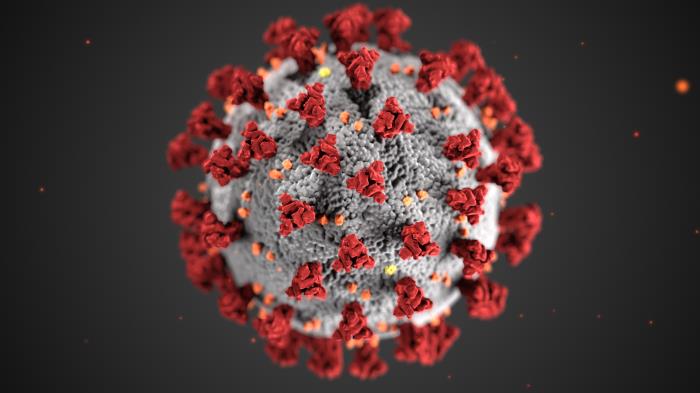
This illustration, created at the Centers for Disease Control and Prevention (CDC), reveals ultrastructural morphology exhibited by coronaviruses. Note the spikes that adorn the outer surface of the virus, which impart the look of a corona surrounding the virion, when viewed electron microscopically. A novel coronavirus, named Severe Acute Respiratory Syndrome coronavirus 2 (SARS-CoV-2), was identified as the cause of an outbreak of respiratory illness first detected in Wuhan, China in 2019. The illness caused by this virus has been named coronavirus disease 2019 (COVID-19). Image: A. Eckert & D. Higgins

Swainsona hardcopies available

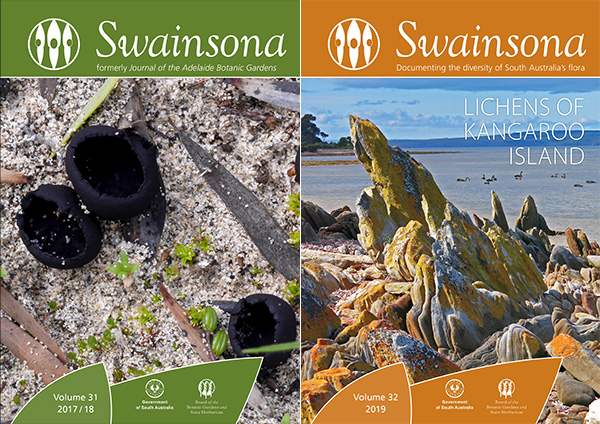
Hardcopies of two volumes of the State Herbarium of South Australia‘s journal Swainsona are now available for purchase.

Vol. 31 contains regular papers of the years 2017/18. The table of contents is available here. Retail price $50.

Vol. 32 is the special volume on Lichens of Kangaroo Island. All species that occur in the region are listed in “An annotated catalogue of the lichens of Kangaroo Island, South Australia”. An overview of this project (3.3mb PDF) that was published in Vol. 30 of the journal is also reprinted in this hardcopy edition. Retail price $42.

Hardcopy of the special volume was officially launched in Hobart by the author, lichenologist Gintaras Kantvilas, in November 2019. Dr Kantvilas is one of Australia’s foremost lichen experts and the Head of the Tasmanian Herbarium.

“This magnum opus presents the results of over 10 years of work on the lichens of Kangaroo Island. During this time, the author undertook extensive fieldwork and reviewed more than 1500 herbarium specimens. The lichen flora of Kangaroo Island consists of 366 taxa, of which 14 are restricted to the island. Ninety-five species are reported for South Australia for the first time, of which 19 are also new records for Australia.

This landmark study is the first to thoroughly examine and document the lichens of the Kangaroo Island. Each species is listed with a short, diagnostic description, many are illustrated with photographs. All specimens used to compile the catalogue of lichens are listed, making this publication an invaluable tool for future research. A brief history of lichenological work on the island is included, as well as a description of the habitats that lichens occur in.”

Published a few months before the devastating bushfires, this volume provides a unique insight into the lichen flora of the island and includes many records from areas that have been burned. It is is also available online (27.9mb PDF).

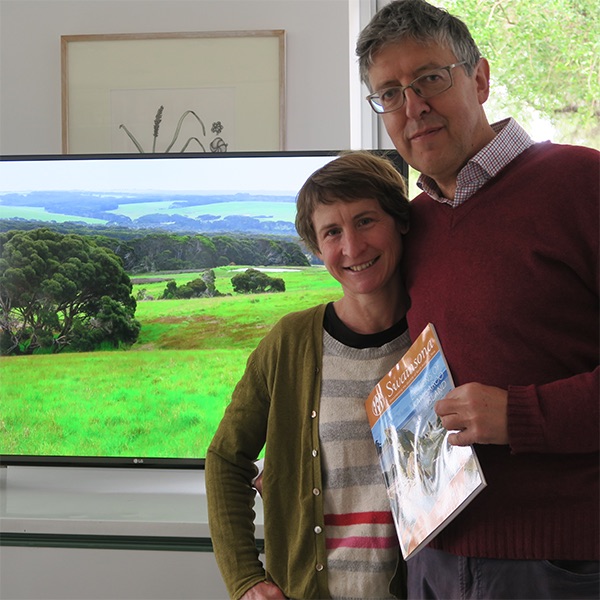
Gintaras Kantvilas and Brigitte de Villiers at the launch of “Lichens of Kangaroo Island” in front of a photo from the island. Photo: G.Kantvilas.

The volumes can be purchased from the front desk of the Botanic Gardens of South Australia, Goodman Building, Hackney Road, Adelaide (phone: 08 8222 9311). Postage will be added, depending on destination.

To access content of all volumes of Swainsona and the Journal of the Adelaide Botanic Gardens since Vol. 1 (1976) online, please visit the journal’s web-site at flora.sa.gov.au/swainsona.

New seedbank stamps

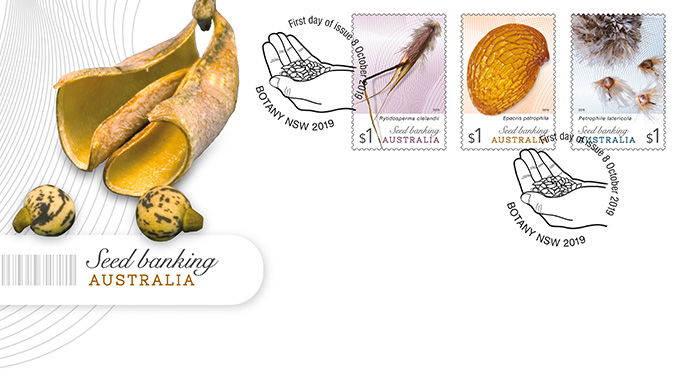
This month, Australian Post released a new set of three stamps about seed banking in Australia. The stamps feature seeds of rare and threatened Australian plants:

The seed image of the South Australian species were provided by the South Australian Seed Conservation Centre at the Botanic Gardens and State Herbarium. The Seed Centre collects seeds from regions across the state to safeguard them in long term storage at sub-zero temperatures. By 2020, the centre aims to have at least 90 per cent of SA’s threatened plant species in the seedbank. The Australian Seed Bank Partnership facilitates and coordinates the activities of the country’s seedbanks.

Details on the individual stamps and an article on seed conservation can be found on the Australia Post website.

Queen’s Birthday Honours

The 2019 Queen’s Birthday Honours list included two names with a close relationship to the State Herbarium of South Australia: Bev Overton and Peter Copley. Bev received the award of Member of the Order of Australia, and Peter received the award of Public Service Medal.

Bev and Dean Overton in their natural habitat (Photo: KI NRM).

Back in February 2016, the State Herbarium did a blog article on Kangaroo Island couple Bev and Dean Overton. The story congratulated them for being recognised as Kangaroo Island high achievers for their outstanding efforts in conserving and raising awareness of KI’s natural environment at the Local Achievers Natural Resource Management Board Awards ceremony held on Australia Day that year.

Richard Tretheway (NRM Board President), Bev and Dean Overton, Damian Miley (DEWNR) (Photo: KI NRM).

Last year the Herbarium was approached by Kangaroo Island environmental consultant and botanist Michelle Haby to help support a nomination for Bev Overton to receive recognition in the 2019 Queen’s Birthday Honours. The final nomination was put together and submitted by Michelle and Bev’s husband Dean. Sadly Dean died unexpectedly before the news of Bev’s successful nomination was known.

You can read more of Bev’s impressive nomination here (156kb PDF). An article in THE ISLANDER newspaper also appeared recently.

Peter’s medal recognises his contribution and commitment of more than 40 years to help conserve threatened species and ecological communities in South Australia, as well as his role in biodiversity research and policy development. Peter reviewed the daisy genus Ixodia for his Honours at the University of Adelaide and has contributed 3601 collections to the State Herbarium over the years. His interest in botany was no doubt inspired by his father Bruce Copley, a Yorke Peninsula farmer who pursued an interest in his local native flora by collecting and submitting many specimens to the Herbarium.

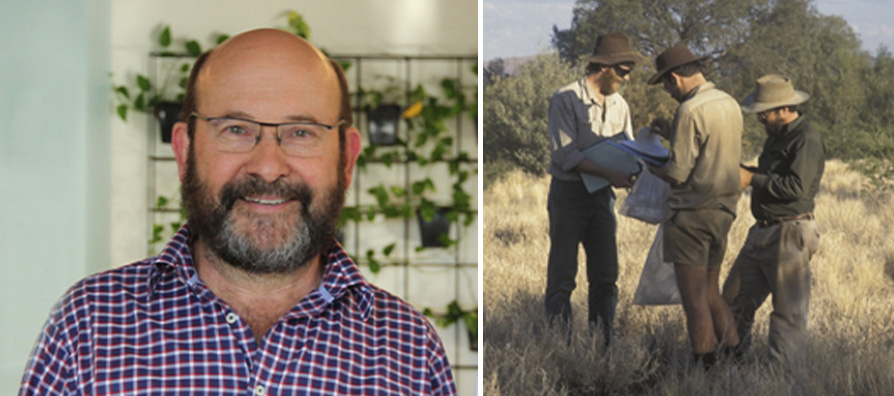
Peter Copley (left image, Courtesy of THE WEEKLY). Peter Canty, Peter Copley and Peter Lang botanising in the APY Lands in 1994 (right image).

Manager Peter Canty and Senior Botanist Peter Lang have worked closely together with Peter over many of those years, especially when they were part of the Biological Survey of South Australia program. Peter Copley lead the over decade-long biological survey of the Anangu Pitjantjatjara Yankunytjatjara Lands. The knowledge captured by that survey was greatly enhanced by working with Aboriginal Traditional Owners and Peter’s ability to establish close working relationships with the elders and their communities was pivotal in this particular survey’s success, and being recognised with a SA Great Award in 2003 in the Environment Category for an ‘Outstanding Contribution to South Australia’.

Read more of Peter’s impressive nomination.

The Herbarium was very pleased to be involved in their nominations and wishes to congratulate them on their well-deserved recognition.

Written by State Herbarium Manager Peter Canty.